Generative AI Invoice Coding: How AP Directors Are Quietly Rewriting the GL Assignment Playbook
Contents
- 1. Why GL Coding Has Resisted Automation Longer Than Everything Else
- 2. The Numbers That Should Be on Your Business Case
- 3. What Generative AI Invoice Coding Actually Looks Like in Practice
- 4. Gen AI vs. Legacy OCR: Why the Distinction Actually Matters
- 5. The Compounding Case for Full Invoice Automation
- 6. What AP Directors Should Actually Evaluate
- 7. FAQs
- 8. Share:
- 9. Recent Post
- 10. Why Finance Transformation Projects Fail at the AP Department, Not the ERP
- 11. Employee-Friendly Expense Policies Are a Control Failure Wearing a Nicer Outfit
- 12. Zero-Based Budgeting Is Dead. Here’s What’s Replacing It in Spend-Conscious Companies
If you run an AP function, you already know the real bottleneck isn’t approvals. It’s coding.
Somewhere in your team, right now, someone is staring at an invoice from a supplier they’ve never seen before, trying to decide which GL code it belongs to, which cost center should absorb it, and whether it needs a PO reference it doesn’t have. Multiply that decision by a few thousand invoices a month, and you understand exactly why AP teams stay understaffed and overwhelmed even after buying “automation.”
Generative AI invoice coding is the part of the automation story that doesn’t get the flashy demo, but it’s the part actually worth your budget in 2026.
Why GL Coding Has Resisted Automation Longer Than Everything Else
Capturing data off an invoice, like vendor name, amount, and date, is a solved problem. OCR has done that reasonably well for over a decade. Coding is harder because it requires judgment: which GL code, which cost center, which department, based on context that isn’t written anywhere on the invoice itself. A traditional rules engine can handle “if vendor = X, always code to Y.” It falls apart the moment a vendor sends a mixed invoice, a new department starts ordering from an existing supplier, or a contract renews under a slightly different line-item description.
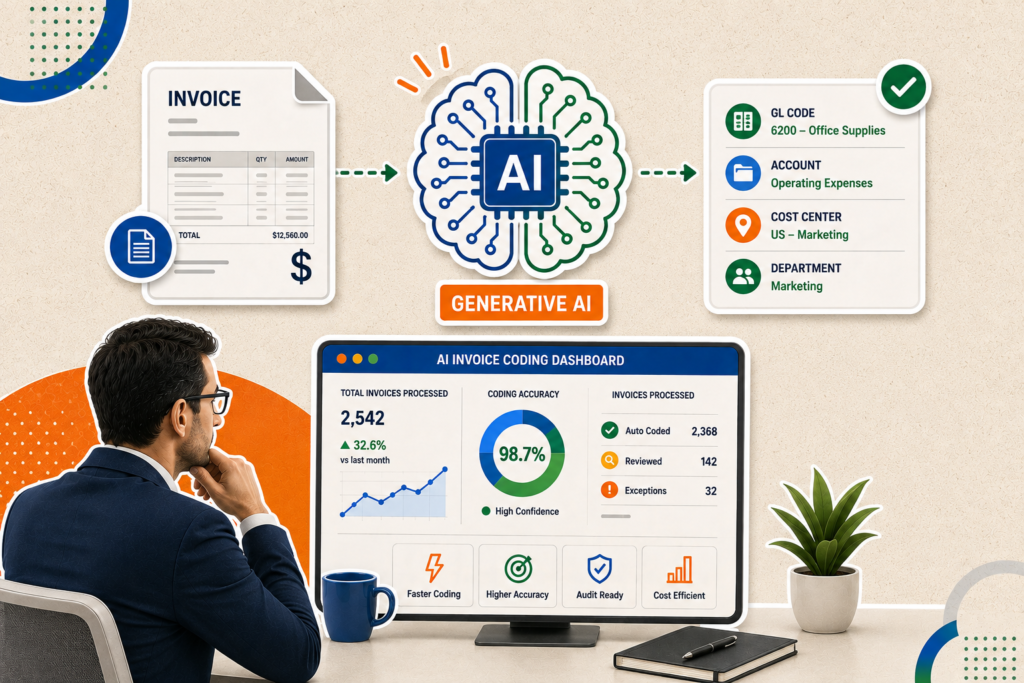
This is exactly the gap generative AI for invoice processing closes. Instead of matching keywords, a generative model reads the invoice the way a trained AP analyst would, understanding line-item descriptions in context, inferring intent from historical coding patterns, and producing a defensible GL assignment with a confidence score attached, not just a guess dressed up as certainty.
The Numbers That Should Be on Your Business Case
Numbers first, since that’s what gets budget approved.
Industry benchmarking research from APQC and Ardent Partners puts manual invoice processing costs between $10 and $22 per invoice, with top-quartile organizations closer to $10.18 and median performers around $21.40. Fully automated, AI-driven processing brings that figure under $1 per invoice in the most mature deployments. For an organization processing 1,000 invoices a month at a manual cost of $15 each, that’s $180,000 a year spent on invoice handling alone, before you even count the cost of errors.
And the errors are real.
Nearly 39% of manually processed invoices contain at least one error, and manual data entry mistakes affect an estimated 1-4% of keyed invoices even under careful review.
AI-assisted invoice capture, by contrast, reaches field-level extraction accuracy above 95%.
That gap isn’t academic; it’s the difference between a clean close and a month-end scramble to trace a miscoded six-figure invoice back through three approval layers.
Speed tells the same story. Ardent Partners’ State of ePayables research shows the all-buyer average invoice processing time sitting at 10.9 days, while best-in-class organizations using AI and automation close the loop in 3.1 days, roughly 72% faster. Straight-through processing, invoices that flow from receipt to payment with zero human keystrokes, averages around 25% across all organizations, but climbs to 35% or higher for top performers.
What Generative AI Invoice Coding Actually Looks Like in Practice
Picture the workflow this way. An invoice lands as a PDF, email attachment, or vendor portal upload- doesn’t matter. A generative AI invoice management software platform reads it, extracts every line item, and doesn’t stop at “amount due.” It reasons through what each line item is, like office supplies versus IT hardware versus a service retainer, and proposes a GL code, cost center, and tax treatment based on how similar line items have been coded historically across the organization.
Where the invoice references a purchase order, generative AI invoice reconciliation software performs the two-, three-, or four-way match automatically, checking the invoice against the PO, the goods receipt, and the original contract terms, and only escalates when something genuinely doesn’t reconcile – like a price variance beyond tolerance, a quantity mismatch, a vendor banking detail that changed since the last payment.
Where there’s no PO, the “non-PO invoice” that historically eats the most AP analyst time, this is where AI invoice management software earns its keep most visibly. The system draws on historical coding precedent, department-level spend patterns, and vendor category to propose a defensible code without a human starting from a blank screen.
Gen AI vs. Legacy OCR: Why the Distinction Actually Matters
A lot of platforms market themselves as “AI-powered” while running on legacy OCR plus a rules engine underneath. The tell is simple: ask what happens when an invoice looks nothing like anything the system has seen before. Legacy OCR either fails outright or produces a low-confidence guess with no reasoning behind it. Gen AI invoice management software built on large language models can explain why it proposed a given code, citing the line-item language, the vendor’s historical coding pattern, and the closest analogous transaction. That explainability is not a nice-to-have. It’s what makes the system auditable, and auditability is what makes your external auditors comfortable letting AI touch the general ledger in the first place.
This is the real distinction behind AI-powered invoice management systems in 2026: not whether they read text off a PDF, but whether they can reason about what that text means in the context of your chart of accounts.
The Compounding Case for Full Invoice Automation
Invoice automation and automated invoice processing used to be treated as a cost-cutting exercise – fewer AP clerks, lower per-invoice cost. That’s still true, but it undersells the bigger shift. When coding, matching, and exception handling all run through the same reasoning layer, invoice automation software stops being a productivity tool and starts being a data quality engine. Clean, consistently coded GL data flows straight into forecasting, budget variance analysis, and audit prep; work that used to happen downstream, manually, months after the fact.
This is also where AP automation and accounts payable invoice automation start to blur into broader financial operations. Missed early payment discounts, for example, are a direct and measurable cost of slow, manually coded AP. Research shows manual AP workflows capture only 20-30% of available early payment discounts, while fast, automated processing pushes capture rates above 80%. On $10 million in annual payables under standard 2/10 net 30 terms, that gap alone is worth $140,000-$160,000 a year, money that’s currently just sitting on the table because coding and approval take too long to hit the discount window.
What AP Directors Should Actually Evaluate
Don’t buy on the demo. Ask three questions instead:
- Can it explain its coding decisions in plain language, tied to specific historical precedent?
If the answer is a black box, your auditors will eventually ask the question you can’t answer. - What’s the exception rate, and what happens to exceptions?
Best-in-class AP teams run exception rates near 9%, versus an industry average closer to 14-22%. Ask specifically how the system routes and resolves the invoices it can’t code confidently. - Does it integrate cleanly with your existing ERP’s chart of accounts, or does it require you to restructure your GL to fit the tool?
The best generative AI invoice coding platforms adapt to your GL structure. The weaker ones ask you to adapt to theirs.
FAQs
Generative AI invoice coding uses large language models to read and interpret invoice line items in context, proposing GL codes, cost centers, and tax treatments based on reasoning and historical precedent, not just keyword matching. Traditional OCR extracts text; generative AI for invoice processing understands what that text means.
Industry benchmarks put manual invoice processing at $10.89-$21.40 per invoice, compared to under $1 to roughly $2.78 for best-in-class automated processing, a cost reduction in the 70-90% range depending on invoice complexity and volume.
Yes. This is one of the strongest use cases. Generative AI invoice reconciliation software draws on historical coding patterns and vendor category data to propose defensible GL codes for non-PO invoices, which previously required an AP analyst to code manually from scratch every time.
For routine, high-confidence invoices, yes, AI-assisted capture reaches field-level accuracy above 95%. Most organizations still route lower-confidence or high-dollar exceptions to a human reviewer, which is the risk-based model best-in-class AP teams use rather than full autonomous approval on every invoice.
Most organizations see measurable reductions in cost-per-invoice and processing time within the first two to three months of deployment, with full ROI, including early payment discount capture and reduced exception handling, typically realized within six to twelve months, depending on invoice volume and integration complexity.
Share:
Recent Post



Know about the latest happenings in the fintech automation.
Click below to subscribe to our newsletter!
-
Near-Touchless
Operation - One-Click Fully Audited Reports
-
Seamless ERP & TMC
Integrations
-
Automated 2/3/4-Way PO
Matching - Effortless Vendor Onboarding
-
Globally-Accepted Smart
Prepaid Cards