Every vendor in the T&E automation space will tell you they’re the best. They’ll show you polished demos, quote impressive client logos, and leave you with a deck that makes their platform look flawless. What they won’t show you is the implementation timeline buried in the Statement of Work, the per-module add-on fees that triple your Year 2 invoice, or the reason their G2 score has been trending downward for eighteen consecutive months.
This blog is different. We’re going to do something the category rarely does: a transparent, honest comparison of how automated expense management platforms actually stack up across the criteria that matter most to CFOs and Finance Directors making real buying decisions. No spin. No misleading capability claims.
We’ll look at three broad categories of platforms: enterprise-tier legacy systems (the big names most organizations already know), mid-market point solutions (lighter tools that handle basic submission and approval), and ExpenseAnywhere – a platform built to deliver enterprise-grade corporate spend management capability at mid-market speed and economics.
Why Most Expense Platform Comparisons Lie to You
The standard vendor comparison framework – feature checklist with checkmarks – is essentially useless for evaluating travel expense solutions. Here’s why: almost every mature platform can put a checkmark next to “multi-currency support,” or “ERP integration,” or “mobile app.” What those checkmarks don’t tell you is how that feature actually works, what it costs to configure, and whether your employees will use it.
Consider “mobile app.” A legacy enterprise platform might have a mobile app that handles receipt submission, but full approval workflows, booking management, and expense creation require the desktop interface. A modern travel expense app delivers complete parity between mobile and desktop, with biometric login, offline mode, and camera-based receipt capture. Both have a checkmark. Only one delivers mobile-first value.
Or consider “ERP integration”. An enterprise platform natively integrates with its parent company’s ERP deeply and well. Integrating the same platform with a different ERP? That typically requires a systems integrator engagement that can run $50,000 to $200,000+. A purpose-built, agile business travel expense management platform delivers turnkey connectors for virtually all major ERPs, no SI required.
The only honest comparison framework looks at real-world capability, total cost of ownership, and the experience of users at companies like yours, not the experience of the reference customers the vendor selected to present to you.
The Comparison: What Actually Matters
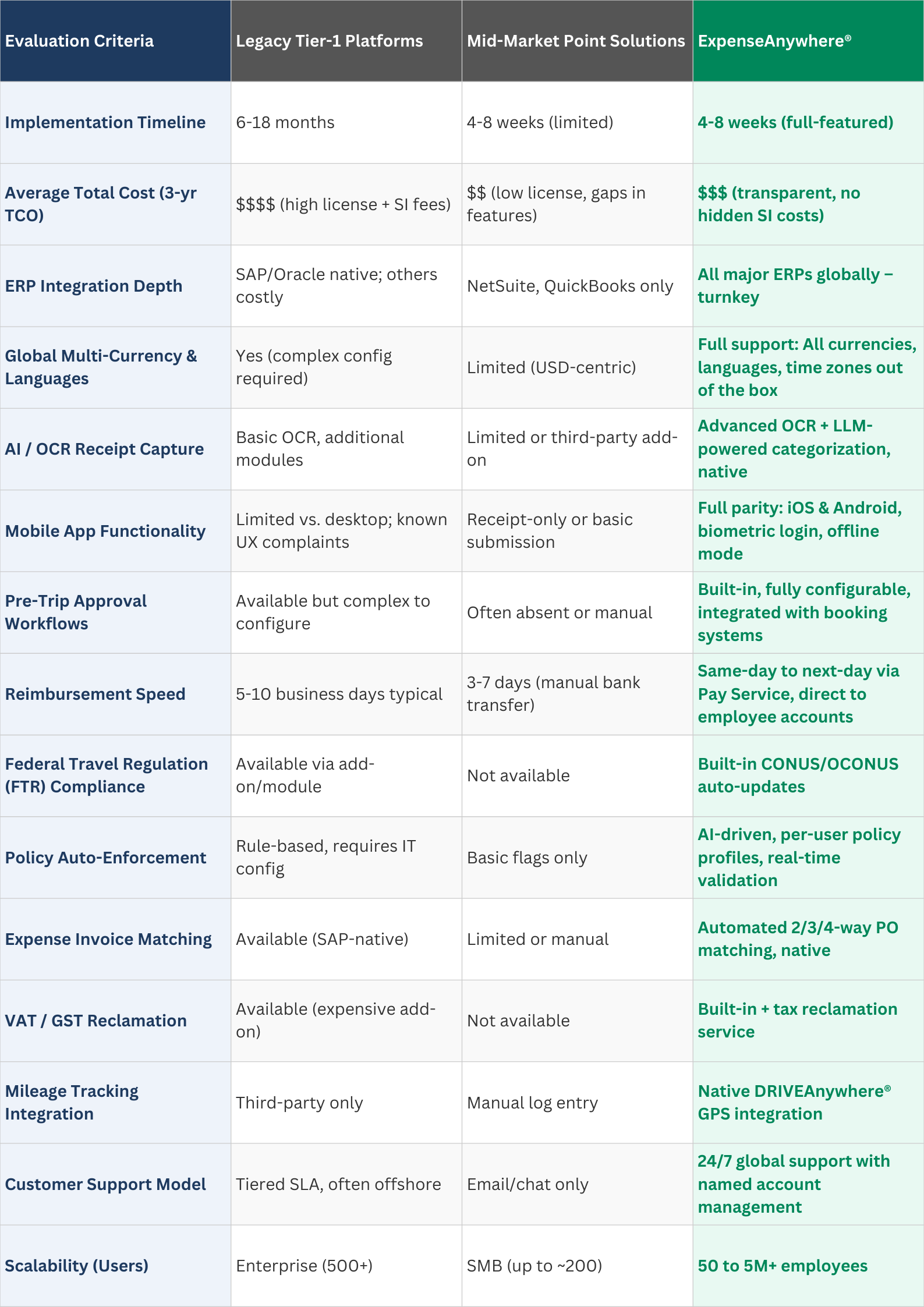
The table below evaluates three platform categories across 15 criteria that genuinely differentiate value for mid-market and enterprise Finance teams. This is the corporate expense management evaluation framework we’d use if we were the buyer.
Reading the Table: Where the Real Differences Live
1. The Hidden Cost Problem
The most consequential row in that table, the one that buyers consistently underweight, is Total Cost of Ownership. Enterprise-tier platforms are notorious for modular pricing architectures that mean the initial license covers basic functionality, while meaningful capabilities (advanced analytics, mobile full-functionality, mileage tracking integration, VAT reclamation, federal travel compliance) sit behind additional fees.
A mid-market company that signs a T&E automation contract at $X per user per month often discovers that the actual cost per user is 2-3x that figure once all required modules are included. This is not a surprise to the vendor. It is frequently a surprise to the buyer.
ExpenseAnywhere’s pricing model includes core capabilities like AI-powered OCR, expense invoice matching, multi-currency support, ERP integration, mobile full-functionality, and pay service, without a modular add-on architecture. The price you see is the cost you pay.
2. The Integration Depth Divide
For organizations running ERPs outside the legacy vendor’s native ecosystem – NetSuite, Sage Intacct, Yardi, RealPage, Epicor, Microsoft Dynamics – the integration story with enterprise platforms is often expensive and slow. Turnkey integration is the exception, not the rule.
Modern automated expense management platforms like ExpenseAnywhere have invested specifically in broad ERP connector libraries precisely because mid-market organizations use a diverse range of ERP systems. This isn’t a marginal differentiator; it’s often the deciding factor for organizations that can’t absorb a six-figure integration project on top of their platform license.
3. Reimbursement Speed as a Strategic Variable
The reimbursement speed row deserves special attention because it connects directly to employee experience and retention. Legacy platforms typically batch reimbursements through the AP cycle, meaning employees wait until the next check run or ACH batch. For companies running weekly AP cycles, that means an average wait of 3-5 business days. For bi-weekly cycles, up to 10 business days.
ExpenseAnywhere’s built-in Pay Service processes reimbursements directly, bypassing the AP cycle, and delivers payment to employee accounts same-day or next-day in their preferred currency. For a field sales team or consulting organization where employees regularly front $500-$2,000+ in travel costs, this isn’t a convenience feature. It’s a competitive advantage in talent retention.
4. Compliance Built In, Not Bolted On
For organizations serving the public sector, defense, or federal government, corporate spend management compliance with Federal Travel Regulations (FTR) is non-negotiable. CONUS and OCONUS per diem rates change regularly, and manually updating policy tables is both error-prone and time-consuming.
ExpenseAnywhere handles this automatically, with built-in FTR compliance and real-time per diem rate updates, a capability that sits behind an additional module fee on legacy platforms, and simply doesn’t exist on mid-market point solutions. Pair this with built-in VAT/GST tracking and a tax reclamation service, and the compliance picture for international organizations becomes significantly stronger.
Conclusion: The Right Platform for Your Scale
There is no universally “best” travel expenses app, only the best platform for your specific scale, complexity, and priorities. What this comparison demonstrates is that the traditional assumption that enterprise-grade capability requires an enterprise-tier platform with enterprise-tier complexity and cost is no longer true.
ExpenseAnywhere was built to close that gap: delivering AI-powered, globally capable, deeply integrated business travel expense management at implementation timelines and price points that work for organizations from 50 to 5M+ employees. With 20+ years of development, $4B+ in annual spend managed, and 113M+ transactions processed annually, the platform’s enterprise-grade credentials are real, without the enterprise-grade implementation burden.
For CFOs evaluating travel expense solutions in 2026, the critical questions are not “which platform has the most features?” but rather: Which platform will your employees actually use? Which platform integrates with your ERP without a six-month SI project? Which platform gives you real-time visibility into committed and actual corporate spend management data? And which platform’s total cost is what it appears to be on day one?
Answer those questions honestly, and the comparison tends to resolve itself.