Picture this: a vendor invoice arrives for 200 units of industrial components at $85 each. Your procurement team ordered 180 units at $82 each. Your warehouse received 175 units. The invoice says $17,000.
Without a structured matching process, that invoice might sail through your approval workflow and get paid. Three separate errors: quantity discrepancy, price discrepancy, and delivery shortfall, and this just cost your business $3,625. Multiply that across thousands of invoices per year, and you’re looking at a material financial control failure.
This is exactly what PO matching is designed to prevent. And in 2026, when intelligent PO matching software has reached a level of sophistication that makes manual verification genuinely obsolete, there’s no excuse for running AP without it.
Let’s break down how each matching type works, what it protects you from, and what to demand from any AP automation platform you’re evaluating.
What Is Purchase Order Matching in AP, and Why Does It Exist?
Purchase order matching (also called invoice matching) is the process of cross-referencing a vendor’s invoice against one or more source documents before releasing payment. The core principle is simple: you should only pay for what you ordered, in the quantity you ordered it, at the price you agreed to, and only after confirming it was actually delivered.
Without this control, AP teams face a range of costly risks:
- Overpayments on incorrect quantities or inflated prices
- Payments for goods or services were never received
- Duplicate invoice payments
- Fraudulent vendor invoices with no legitimate PO backing
- Compliance violations from unauthorized spend
The scale of the problem isn’t theoretical. In 2024, 79% of businesses experienced payment fraud, with average losses of $145,000 per incident. Research by Ardent Partners places the average invoice exception rate at 20.7%, meaning more than one in five invoices that enter a typical AP process has some form of discrepancy requiring resolution.
PO matching is the systematic, scalable answer to these risks. And automated PO matching is what allows AP teams to apply that control to every single invoice, consistently, without human fatigue or oversight gaps.
2-Way vs. 3-Way vs. 4-Way PO Matching: A Plain-English Breakdown
2-Way PO Matching: The Baseline Control
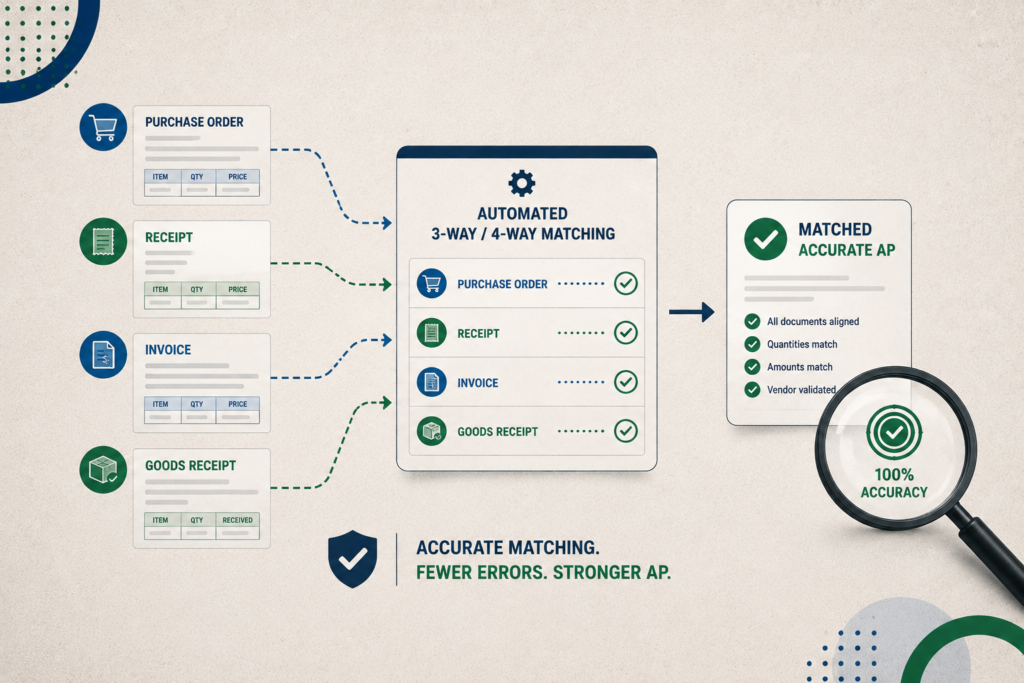
Two-way matching compares two documents:
- The Purchase Order (PO) – what was approved and ordered
- The Vendor Invoice – what the supplier is billing
The system checks that the invoice quantities and prices match the PO within your configured tolerance thresholds. If they align, the invoice is approved for payment. If they don’t, it’s flagged as an exception.
When it’s appropriate: Services, software subscriptions, consulting engagements, and any procurement where there is no physical delivery to verify. You ordered the service, the service was performed, and the invoice matches the agreed price – that’s sufficient for payment.
What it doesn’t protect against: Delivery shortfalls. If you ordered 500 units and only 400 were delivered, 2-way matching won’t catch the discrepancy because it’s not checking a goods receipt note.
3-Way PO Matching: The Gold Standard for Goods-Based Purchasing
Three-way matching adds a third document to the comparison:
- The Purchase Order
- The Vendor Invoice
- The Goods Receipt Note (GRN)/Receiving Report
The GRN is the internal document your receiving team creates when goods arrive, confirming what was actually delivered in what quantity. Three-way matching verifies that all three documents – what was ordered, what was received, and what’s being billed – align before payment is released.
The protection this adds is significant. According to APQC benchmarks, companies using 3-way matching reduce payment errors by 60-70%. Consider what this catches that 2-way matching misses:
- Vendor bills for 200 units, PO is for 200 units, but only 175 were delivered.
- Vendor ships a substituted product at a higher price point than what was ordered.
- The receiving team logs delivery against the wrong PO line.
- Vendor double-invoices for a shipment that was partially returned.
When it’s appropriate: Manufacturing, distribution, retail, healthcare supply chains, and any business that regularly purchases physical goods. This is the baseline expectation for any company with meaningful procurement volume.
The manual challenge: Three-way matching manually means your AP team is cross-referencing three separate documents, often across different systems, for every single goods-based invoice. At high volumes, this becomes the primary driver of AP department staffing costs and processing delays.
4-Way PO Matching: The Standard for Quality-Critical Industries
Four-way matching extends the verification by adding a fourth document:
- The Purchase Order
- The Vendor Invoice
- The Goods Receipt Note (GRN)
- The Inspection Report / Quality Acceptance Report
The inspection report confirms not just that goods were received, but that they passed quality verification against the specifications in the PO. Payment is only authorized when all four documents align.
When it’s essential: Pharmaceutical and biotech companies (GxP compliance requirements), aerospace and defense manufacturing (component specification verification), food and beverage production (safety and quality standards), medical device procurement, and any industry where delivered goods must meet documented quality standards before use.
What the additional step prevents: Paying for non-conforming goods that will need to be returned or reworked, approving payment before quality holds are resolved, and creating audit trail gaps in regulated industries.
How Automated PO Matching Catches What Manual Review Misses
Manual PO matching isn’t just slow. It’s structurally unreliable in ways that automation fundamentally addresses.
1. Scale and Consistency
A human AP professional reviewing invoices manually has cognitive limits. Fatigue sets in. Routine invoices from familiar vendors get approved with less scrutiny. High-volume periods create pressure to process quickly. Automated matching applies the same rules, at the same tolerance thresholds, to every single invoice, every time. There is no Friday afternoon effect in automated matching.
2. Data Complexity
Modern supply chains generate invoices with dozens of line items, multiple currencies, variable tax treatments, and complex pricing structures that include volume discounts, contract-specific rates, and freight charges. Manual matching across this complexity is where the 20.7% exception rate comes from, not because AP professionals are careless, but because the data complexity exceeds what manual review can reliably handle.
AI and OCR-powered automated matching extracts and validates this complexity systematically. Machine learning models that learn from your supplier data and transaction history can identify pattern-based discrepancies that manual review would never surface, like a vendor whose average invoice amount has drifted 8% above contract rates over six months.
3. Exception Intelligence vs. Exception Volume
This is the critical difference between basic and intelligent PO-matching software. A basic system flags exceptions and drops them in a queue. An intelligent system analyzes the exception, identifies the most likely cause (price discrepancy vs. quantity mismatch vs. PO reference error), suggests the appropriate resolution action, and routes it to the person with the authority and context to resolve it.
The practical impact: your AP team stops spending time figuring out what’s wrong with flagged invoices and starts spending time resolving them. That’s a fundamentally different and dramatically more efficient workflow.
From Goods Receipt to Invoice Approval: The Complete Intelligent Matching Workflow
Understanding how intelligent PO-matching software handles the full workflow from receiving through payment helps clarify what you should expect from any platform you evaluate.
Step 1: Invoice Ingestion
Invoices enter the system through any channel, like email attachments, supplier portal submissions, EDI transactions, or scanned documents. AI-powered OCR and document intelligence extracts structured data from any format, capturing invoice number, date, vendor, line items, quantities, unit prices, totals, and tax amounts. The system learns and improves accuracy over time across supplier-specific formats.
Step 2: PO and GRN Retrieval
Using the PO number on the invoice (or a matching algorithm when the reference is missing for non-PO invoices), the system retrieves the corresponding purchase order directly from your connected ERP. For 3-way and 4-way matching, it simultaneously retrieves the associated goods receipt records and, where applicable, inspection reports.
Step 3: Automated Matching Against Tolerance Rules
The invoice is compared line-by-line against the retrieved PO and receipt data. Configured tolerance rules, which can be set by vendor, product category, invoice value, or any combination, determine what constitutes an acceptable match. Invoices within tolerance are automatically approved for payment. Those outside tolerance generate structured exceptions.
Step 4: Intelligent Exception Handling
Exceptions include classification (price discrepancy, quantity mismatch, missing GRN, unrecognized vendor, duplicate detection), likely root cause analysis, suggested resolution actions, and routing to the appropriate team member with context. This is where the quality gap between platforms is most visible.
Step 5: Concurrent Approval and Payment
Approved invoices, whether auto-approved or exception-resolved, are routed through your configured approval workflow. Intelligent platforms support concurrent cost-center-based approvals rather than sequential ones, compressing the total approval time significantly. Invoices with early payment discount eligibility are identified and prioritized. Once approved, payment is initiated through the appropriate payment rail in the vendor’s preferred currency.
What to Demand from Intelligent PO Matching Software in Your Evaluation
When you’re evaluating AP automation platforms, here’s specifically what to probe on matching capabilities:
- Native support for 2-way, 3-way, and 4-way PO matching without additional modules or fees.
- Configurable tolerance thresholds by vendor, category, and invoice type.
- AI-driven exception analysis with resolution suggestions, not just exception flags.
- Real-time PO and GRN retrieval from your ERP, not batch synchronization.
- Duplicate invoice detection that works across vendors with similar invoice formats.
- Line-item level matching, not just header-level total comparisons.
- Audit trail that captures every matching decision, tolerance application, and resolution action.
- Touchless processing rate benchmarks from customers with similar invoice profiles.
The market in 2026 has platforms that deliver genuinely autonomous matching at scale. The question is whether you’re asking the questions that will find them.
The Business Case: What Intelligent GRN Matching Actually Saves
Let’s put some numbers to the impact of moving from manual to intelligent automated PO matching.
For a mid-market manufacturing company processing 3,000 invoices per month at an average of $12.88 per invoice manually, the annual processing cost is approximately $463,000. Moving to best-in-class automated matching at $2.78 per invoice brings that to $100,000, a saving of $363,000 annually before any consideration of fraud prevention or early payment discount capture.
Add to that: at a 20.7% exception rate without intelligent matching, that same company is generating 621 exceptions per month. If each exception takes 30 minutes of AP team time to investigate and resolve, that’s 310 hours per month, or roughly two full-time AP employees doing nothing but chasing invoice problems. Intelligent matching with AI-guided resolution guidance can reduce investigation time per exception by 50-70%, freeing those resources for work that actually grows the business.
The ROI on genuine AP accuracy isn’t theoretical. It’s built into every invoice your business processes.
FAQs
Three-way matching compares the purchase order, vendor invoice, and goods receipt note to verify that what was ordered and received matches what’s being billed. Four-way matching adds a quality inspection or acceptance report to the comparison. If your business purchases physical goods without specific quality verification requirements, 3-way matching is the appropriate standard. If you operate in a regulated industry where delivered goods must meet documented quality specifications before acceptance, like pharmaceutical, aerospace, food safety, medical devices, a 4-way matching is not optional; it’s a compliance requirement.
Yes, and this is an important differentiator between basic and intelligent PO matching software. Basic systems require a PO number on the invoice for matching to occur. Intelligent systems use AI-powered search to match invoices to POs based on vendor identity, invoice amounts, line-item descriptions, and date ranges, even when the PO reference is missing or incorrect. This matters because a significant percentage of real-world invoices, particularly from smaller vendors, arrive without clean PO references.
A tolerance threshold defines the acceptable variance between an invoice and its matching PO or receipt before the system treats the difference as an exception. For example, a 2% price tolerance means invoices priced within 2% of the PO rate are automatically approved; those outside that range are flagged. Thresholds should be configured by vendor (more flexibility for strategic long-term suppliers, tighter controls for new or one-time vendors), by product category (tighter for high-value components, more flexibility for consumables), and by invoice value (tighter absolute dollar thresholds for larger invoices). Overly generous tolerances allow errors through; overly tight tolerances create exception volume that overwhelms your AP team.
True ERP integration for PO matching means real-time, bidirectional data flow, not batch synchronization. The AP automation platform should pull PO data, vendor master records, and goods receipt information directly from your ERP in real time when matching an invoice, and post matched and approved invoices back to the ERP automatically. This eliminates dual entry, ensures matching is performed against current PO data rather than a potentially outdated snapshot, and maintains a single source of truth across your financial systems.
When a 3-way match fails, meaning the invoice, PO, and GRN don’t align within tolerance, the exception management process determines how quickly and cleanly the issue is resolved. A basic system drops the exception in a queue for manual investigation. An intelligent system classifies the exception type (price discrepancy, quantity variance, missing receipt, PO reference error), identifies the most likely root cause based on historical patterns, suggests a resolution action (contact vendor, request credit note, verify receiving records, update PO), and routes it to the right person with that context attached. Exception resolution time drops dramatically, and the people resolving exceptions are doing so with information rather than investigative work.