For most of its history, expense management was essentially a data entry problem dressed up as a finance function. Someone spent money. Someone else entered that spending into a system. A third person checked whether it followed the rules. A fourth person approved it. A fifth person posted it to the ledger. And so on, in an endless, expensive chain of human touchpoints that added time but rarely added intelligence.
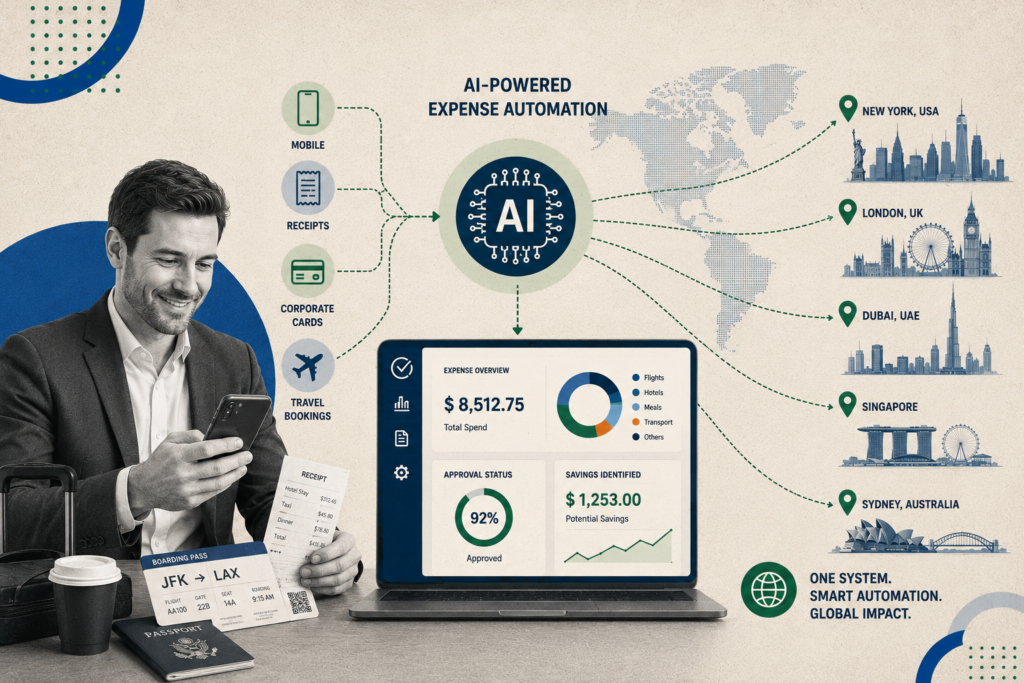
Artificial intelligence has broken that chain. Not gradually but dramatically, and in ways that are reshaping what T&E automation means for global enterprises operating across currencies, languages, regulatory environments, and time zones.
This isn’t a future-state story. The AI transformation of business travel and expense management is happening now, in production deployments, at scale. Here’s what it actually looks like, and why it matters for finance leaders running global operations.
From Rule-Based to Reasoning-Based: The Fundamental Shift
The first generation of expense management automation was rule-based. You defined a rule – “flag any meal expense over $50” – and the system applied it consistently. That was genuinely useful. It was also fundamentally limited, because financial behavior doesn’t fit neatly into rules. Context matters enormously.
A $200 restaurant charge is out of policy for a junior analyst submitting an internal team lunch in Cincinnati. It is entirely appropriate for a VP of Sales hosting four C-suite clients at a client dinner in New York. A rule-based system treats both identically. An AI-powered system understands the difference.
Modern AI-driven automated expense management platforms use large language models and machine learning to evaluate expenses in context – considering the employee’s role, location, the nature of the meeting, the client involved, and dozens of other variables simultaneously. This is reasoning-based validation, not rule-based checking. And the quality of the output is categorically different.
Six Ways AI Is Specifically Transforming T&E for Global Enterprises
1. Intelligent Receipt Processing That Actually Works
Receipt OCR has existed for years, but early implementations were notoriously unreliable – misreading amounts, missing tax line items, failing on foreign-language receipts or unusual layouts. AI-powered OCR using large language models has changed this fundamentally.
Modern automated expense reporting platforms now capture complete receipt data with high accuracy across languages, currencies, and receipt formats. A French restaurant receipt photographed at an angle in poor lighting is parsed as reliably as a printed hotel folio. The system extracts merchant name, date, total amount, tax components, and category, and maps each field to the correct expense attributes, without human intervention.
For global enterprises with employees submitting receipts in dozens of languages across scores of countries, this capability alone represents a transformational improvement in T&E automation accuracy and throughput.
2. Predictive Categorization Before the Employee Acts
The most advanced expense management automation platforms no longer wait for employees to categorize their expenses. AI models trained on each organization’s historical spending patterns, combined with real-time data from corporate card feeds, travel bookings, and calendar integrations, predict what an expense is before the employee opens the app.
When a sales rep’s corporate card is charged at a Marriott hotel in Frankfurt two days into a booked client trip, the system doesn’t ask what category this belongs to. It already knows – hotel accommodation, client-related, European travel, correct cost center, and appropriate GL code. The expense is created, categorized, and policy-checked before the employee’s flight home.
This predictive layer is what enables genuinely zero-touch automated expense reporting, and it’s now available in production platforms, not just proof-of-concept demos.
3. AI-Driven Fraud Detection That Scales with Your Workforce
Expense fraud is a persistent and underappreciated problem. According to the Association of Certified Fraud Examiners (ACFE), expense reimbursement fraud costs organizations a median of $40,000 per incident and is present in approximately 15% of all occupational fraud cases. Manual audit processes catch a fraction of these cases, not because auditors aren’t diligent, but because the patterns are subtle and the data volume is massive.
AI changes the detection math entirely. Machine learning models monitor behavioral patterns across the entire employee population, simultaneously identifying anomalies that would be invisible to any human reviewer. A sales rep who consistently submits mileage claims for routes that don’t match GPS data. An employee whose receipt timestamps suggest they were in two cities on the same day. Duplicate submissions with slight variations in amount or date are designed to evade simple duplicate-detection rules.
These patterns are invisible to rule-based expense tool implementations. They are precisely what AI behavioral models are built to surface. For global enterprises with thousands of employees across dozens of countries, this detection capability is not optional; it’s essential.
4. Real-Time, Geolocation-Based Tax Compliance
Global business travel and expense management means navigating a labyrinth of country-specific tax regimes: VAT in Europe, GST in Australia and India, HST in Canada, sales tax jurisdictions in the US that change at the county level. Getting this right in real time for every expense, in every jurisdiction, is computationally impossible for a human workforce and entirely within the capability of an AI-powered platform.
Leading T&E automation platforms now conduct real-time, geolocation-based tax audits on every expense submission, identifying applicable tax rates, flagging recoverable VAT, calculating use tax liability for US entities, and generating reclamation reports that help organizations recover taxes they’ve already paid. For global enterprises, recoverable VAT alone can represent hundreds of thousands of dollars annually – money that manual processes consistently leave on the table.
5. Natural Language Policy Interpretation
Expense policies are written by humans, for humans, which means they’re ambiguous, incomplete, and subject to interpretation. “Reasonable meals” means different things in different cities. “Client entertainment” has different boundaries in different industries and regulatory environments. Traditional rule-based expense management automation can only enforce what can be coded into explicit rules.
AI-powered policy engines use natural language processing to interpret policy intent, not just policy text. They can evaluate whether a $95 meal in San Francisco is “reasonable” in the context of local cost of living, the nature of the meeting, and the seniority of the attendees, and make a validated, explainable decision. This dramatically reduces the volume of borderline exceptions that require manual review, freeing finance teams to focus on genuinely complex judgment calls.
6. Automated Expense Report Generation Without Employee Input
The logical endpoint of AI-powered automated expense management is an expense report that creates and submits itself. This is not a future concept, as platforms like ExpenseAnywhere are deploying this capability now, with fully automated report generation based on corporate card transactions, travel booking data, and receipts extracted from business email (with user permission).
Reports are generated on a configurable schedule, like weekly, bi-weekly, or per-trip, validated against policy, and routed for approval automatically. If no exceptions are flagged, the report completes the approval workflow and triggers reimbursement without any employee action required. Employees only interact with the system when a genuine exception needs their input.
For a global enterprise with thousands of traveling employees, this represents a step-change in productivity. The time employees previously spent on automated expense reporting administrative tasks is fully recaptured.
Conclusion: The Global Enterprise Imperative
For organizations operating across multiple countries, the AI transformation of T&E automation isn’t a convenience; it’s a competitive necessity. The complexity of managing business travel and expense management across 20 or 30 countries with different currencies, languages, tax regimes, per diem standards, and regulatory requirements is simply beyond what manual or rule-based systems can handle reliably.
A 2024 Hackett Group study found that world-class finance organizations spend 40% less on T&E processing than typical organizations, and that the primary differentiator is the depth of AI and automation integration in their expense management automation stack. The gap between AI-enabled and manually-managed T&E operations is not narrowing. It is widening.
The finance leaders who will define best practice in global corporate spend over the next five years are the ones making the transition now, before the operational and compliance costs of the status quo become impossible to ignore.
FAQs
Traditional OCR converts receipt images to text but requires structured templates to extract meaning, making it fragile when receipts deviate from expected formats. AI-powered OCR using large language models understands receipt content semantically, not structurally. It can correctly interpret a handwritten Japanese restaurant receipt, a European hotel folio with VAT breakdowns, or a fuel receipt with multiple line items, extracting the right data fields accurately regardless of format, language, or image quality. This dramatically improves automated expense reporting accuracy for global workforces.
Yes, and this is one of the most high-value capabilities for global enterprises. Modern T&E automation platforms use geolocation data and AI-powered tax rule engines to identify the applicable tax treatment for every expense in real time. This includes flagging recoverable VAT in EU countries, calculating GST/HST in Canada, identifying use tax liability in US jurisdictions, and generating country-specific tax reclamation reports. For organizations with significant international travel, automated tax compliance and reclamation can recover substantial amounts of tax that manual processes routinely miss.
AI fraud detection in automated expense management works by building behavioral models of normal spending patterns for each employee, department, and organizational level then flagging statistically significant deviations from those patterns. This includes detecting mileage claims that don't match GPS routing data, receipts with metadata inconsistencies, duplicate submissions with minor variations designed to evade simple rules, split transactions intended to stay below approval thresholds, and temporal anomalies suggesting fabricated receipts. These pattern-based detections surface fraud that rule-based expense tool implementations consistently miss.
Zero-touch expense reporting refers to the automatic creation, categorization, policy validation, and routing of expense reports without employee input. It is available today in leading expense management automation platforms, using a combination of corporate card transaction feeds, travel booking data, AI-powered receipt processing, and automated GL assignment. Fully no-touch report generation, where reports are created and submitted on a schedule without employees ever logging in, is done by platforms like ExpenseAnywhere.
AI scales infinitely in ways that human-dependent processes cannot. An AI-powered business travel and expense management platform applies identical validation logic, policy enforcement, fraud detection, and tax compliance checks to the 50th expense report and the 50,000th simultaneously without fatigue, inconsistency, or error accumulation. For global enterprises, this means policy is enforced uniformly across all geographies, all languages, and all currencies, regardless of headcount or geographic distribution. This is the fundamental reason why the Hackett Group consistently finds that world-class finance organizations those with the deepest AI integration in their T&E automation stack operate at dramatically lower cost per transaction than their peers.