
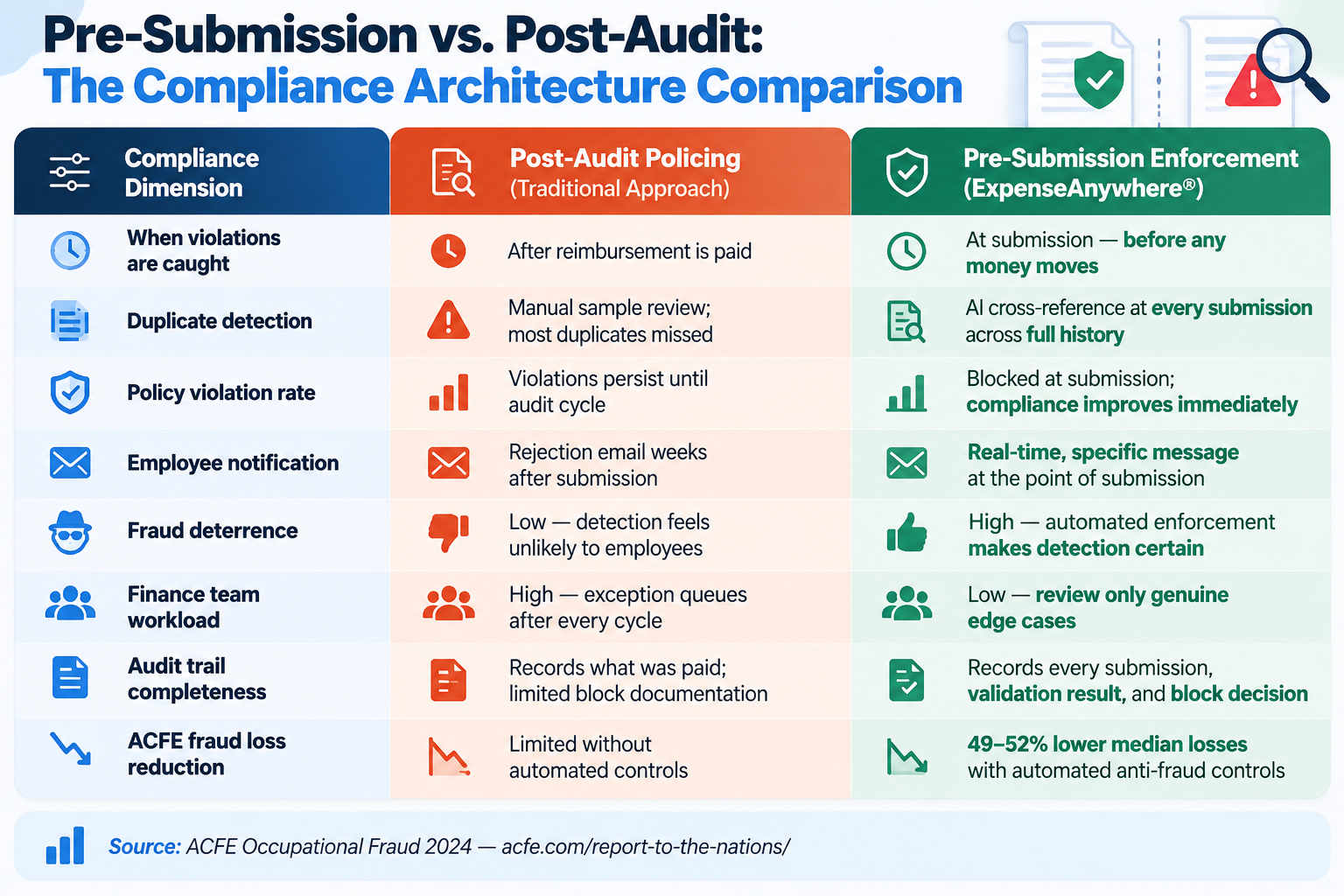
There are two fundamentally different architectures for expense fraud prevention in corporate expense tracking systems. The first is post-audit policing that detects fraud after money has already moved. Expense reports are approved, reimbursements are paid, and a quarterly audit or random sample catches anomalies weeks or months later. The second is pre-submission enforcement, which validates every expense against policy rules before the report ever reaches a human approver. The first approach documents expense fraud. The second prevents it.
The ACFE Occupational Fraud 2024 Report found that the median duration of asset misappropriation fraud before detection is 12 months, with a median loss of $120,000 per case. Expense accounts fraud contributes to this category in 21% of fraud cases at small businesses and 11% at larger organizations. Critically, organizations with automated anti-fraud controls recorded median losses 49-52% lower than those without.
AI catches duplicate receipt submissions by extracting a digital fingerprint from each receipt using OCR – capturing vendor name, date, amount, and tax components – then running a real-time cross-reference against every prior submission across all employees and all time periods. Out-of-policy spending is caught by a real-time policy engine that validates each expense against the submitter’s specific policy profile at the moment of submission, blocking or escalating non-compliant items before they reach an approver. ExpenseAnywhere® (T&E) by ExpenseAnywhere Corporation enforces both simultaneously through its Smart Autonomous Touchless Technology, as part of an integrated expense report management architecture that eliminates manual policing.
The Two Architectures of Expense Compliance
Post-audit expense control is reactive. It relies on human reviewers, random sampling, or periodic audits to identify policy violations and fraudulent claims after reimbursements have been processed. In practice, reviewers approve most submissions without detailed scrutiny because volume is too high for per-item review. Business expense fraud that is “sensibly sized” – as 42% of employees in a Webexpenses survey described their own fraudulent claims – is specifically designed to stay below the threshold of scrutiny. More than eight in ten employees in the same survey had never had an expense claim challenged or declined.
Pre-submission enforcement is structural. Every expense is validated by the system before it becomes a completed submission. The employee learns of a compliance issue at the moment they can still correct it. The approver never sees a non-compliant item. No fraudulent reimbursement is processed. And the audit trail documents not just what was paid but what was blocked and why.
(Source: Webexpenses employee survey — webexpenses.com)
How AI Detects Duplicate Receipt Submissions in Expense Reporting Systems
Duplicate receipt detection in modern expenditure tracking software operates through a multi-stage process beginning at the point of receipt capture. When an employee submits a receipt, photographed on mobile, emailed, or uploaded, the AI extracts structured data like merchant name, address, total amount, line items, tax components, date, and time. This extracted data generates a composite digital record that is immediately compared against the complete submission history of the entire organization.
The comparison is not a simple exact-match check. A duplicate detection system designed for real-world expense fraud handles near-duplicate submissions where amounts, dates, or merchant names have been slightly altered: a $150 restaurant receipt submitted twice with different dates; the same hotel folio with the room rate adjusted by $10; a fuel receipt where the amount has been modified by a few dollars. Pattern-matching algorithms identify these near-matches across three dimensions simultaneously – transaction amount, merchant identity, and date proximity – flagging combinations that would escape human review at volume.
For corporate card programs, a fourth validation layer compares the submitted receipt against the independently sourced card transaction record. When the card transaction amount does not match the submitted receipt amount, or when the merchant on the receipt does not match the card merchant record, the discrepancy is flagged as a potential alteration before approval, closing the most common manual alteration vector in expense accounts fraud.
What a Real-Time Policy Engine Validates Per Submission
Duplicate detection is one function of a pre-submission policy engine. A comprehensive expense control system validates every submission against a configurable rule set that reflects the organization’s specific expense policy before any approval step occurs. The categories that prevent the highest dollar value of policy leakage are:
- Per diem exceedances: Meal expenses above the city-specific or trip-type per diem rate are flagged with the applicable cap and the excess amount
- Hotel rate violations: Nightly rates above the GSA rate, company-specific cap, or city-tier limit are identified with the permitted ceiling
- Non-reimbursable categories: Alcohol, personal entertainment, and personal care items are identified from receipt line-item data and deducted automatically
- Receipt-less submissions: Expenses above the documentation threshold without supporting receipts are blocked at submission
- Missing business purpose: Meal and entertainment expenses without a stated client name or business purpose cannot proceed
- Split-transaction detection: Multiple submissions from the same merchant on the same date, each below a review threshold – a tactic used to avoid per-item scrutiny – are identified through pattern analysis
- Out-of-policy travel bookings: First-class airfare, non-preferred hotels, and unbooked trips are flagged against booking policy rules
Pre-Submission vs. Post-Audit: The Compliance Architecture Comparison
ExpenseAnywhere® (T&E): How the Policy Engine Works at Enterprise Scale
ExpenseAnywhere® (T&E) by ExpenseAnywhere Corporation runs its policy enforcement engine in real time at the point of every expense submission – before the report enters any approval workflow. Each expense is validated simultaneously against three rule layers:
- The user’s specific policy profile – per diem tier, approved expense categories, booking channel requirements for their role and location
- The organization-wide rule set – receipt thresholds, non-reimbursable categories, split-transaction patterns, and hotel/travel booking policies
- The full historical submission record – duplicate detection across all employees and all reporting periods
Non-compliant expenses are blocked with a specific, actionable message identifying the violated rule and the corrective action available. Genuine exceptions can be escalated through a documented override workflow requiring a manager justification note – creating a clean audit trail for the exception rather than allowing it to pass silently.
The system logs every submission decision – approved, blocked, escalated, or overridden – with timestamp and actor identity, generating the structured, system-sourced audit trail that internal and external auditors require for SOX compliance reviews and DCAA incurred cost audits.
This pre-submission architecture does not replace approvers – it changes what they approve. Instead of scanning every line item for potential violations, approvers receive only policy-validated submissions with the validation output attached. Exception-based approver attention is concentrated where human judgment is genuinely required, not distributed across the full population of routine, compliant submissions.
The Numbers Behind Pre-Submission Enforcement
For a mid-market company processing 600 expense reports per month, a typical policy exception rate in a manually policed environment is 15-20%, meaning 90-120 reports per month containing at least one violation that should be rejected or corrected. Each of those exceptions requires manual identification, communication back to the employee, correction, and re-review, an average of 45-60 additional minutes of combined employee and finance team time per exception.
Pre-submission enforcement converts most of these exceptions into immediate self-corrections: the employee sees the specific issue, corrects it, and resubmits – a 60-second interaction rather than a multi-day review cycle. The residual exception rate in well-configured pre-submission environments typically drops to 3-5% of submissions, representing only the genuine edge cases that require manager judgement. The administrative time savings compound directly into faster close cycles and reduced headcount pressure on finance teams managing growing transaction volumes.