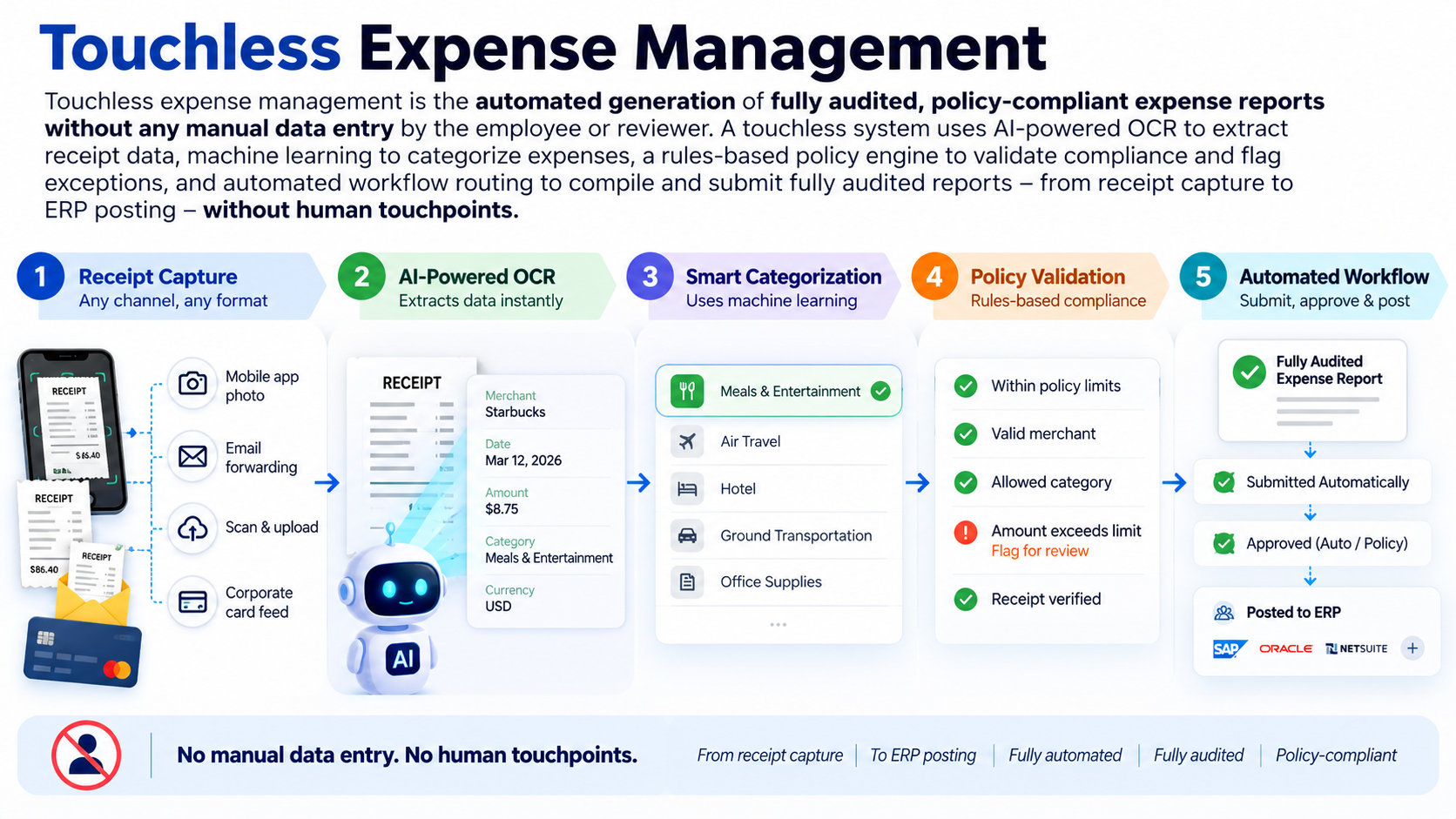
The phrase “touchless expense management” has been in the market long enough to be used loosely. Some vendors apply it to any platform with a mobile app. Others use it to mean OCR-assisted data entry. Neither is accurate. Touchless expense management has a specific technical meaning that, when delivered genuinely, eliminates human involvement from expense report creation entirely, not just from receipt capture, but from data extraction, categorization, policy validation, GL allocation, duplicate detection, and report compilation.
This article provides the authoritative definition of touchless expense automation, maps the three tiers of the market by actual automation depth, and identifies the platforms that deliver genuine autonomous expense report generation versus those that market the term while requiring meaningful manual steps.
The authoritative test for touchless expense management: after an employee photographs a receipt, how many additional manual steps are required before a fully audited, ERP-posted expense entry exists?
In a genuinely touchless system, the answer is zero for standard expenses. In most “automated” systems, the answer is between three and seven.
Traditional vs. Touchless Expense Software: The Technical Gap
To understand what touchless expense automation actually eliminates, it helps to map the manual steps in a traditional expense management workflow. In a conventional process, an employee photographs a receipt (Step 1), then reviews and corrects the OCR-extracted data (Step 2), then manually selects the expense category (Step 3), then enters the business purpose (Step 4), then assigns the cost center or project code (Step 5), then adds the expense to a report (Step 6), then submits for approval (Step 7), then the approver reviews every line item (Step 8), then finance reconciles the approved report against card transaction data (Step 9), then AP posts the entry to the ERP (Step 10).
A touchless system performs Steps 2 through 10 automatically. The employee’s only interaction is the receipt photograph and, for expenses where policy exceptions require justification, a one-sentence note. Every other step is handled by the platform’s AI, policy engine, and ERP integration layer.
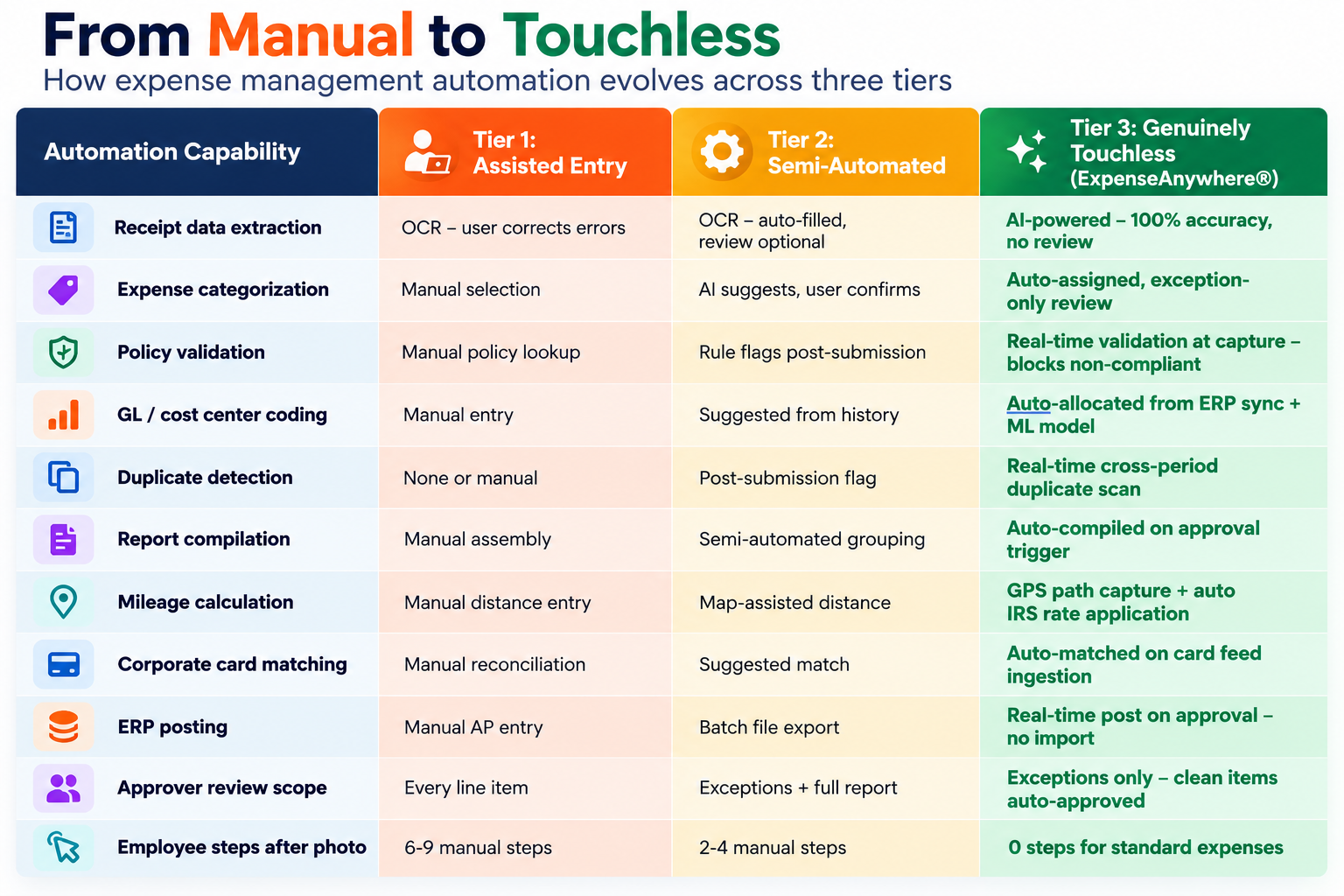
The distinction matters because the efficiency and compliance benefits of expense automation are almost entirely proportional to how many of those 10 steps the system actually handles. A platform that automates Steps 2-3 (OCR extraction and category suggestion) but requires manual completion of Steps 4-10 has not delivered touchless expense management. It has delivered assisted data entry.
The Three Tiers of T&E Automation by Actual Touchlessness
How ExpenseAnywhere®’s Touchless Engine Works: Step by Step
ExpenseAnywhere®’s Smart Autonomous Touchless Technology, the platform’s proprietary automation engine, processes an expense from receipt photograph to ERP-posted, audited entry through a sequence that requires zero manual input for policy-compliant standard expenses.
The employee photographs the receipt using the ExpenseAnywhere® mobile app or emails it to their personal receipt store in the platform. The AI extraction engine, trained on millions of receipt formats across dozens of countries and merchant categories, extracts vendor name, date, amount, currency, line items, and tax components. Extraction accuracy is 100% on standard receipt formats, with confidence scoring that identifies the small percentage requiring review.
The extracted data is cross-referenced in real time against three concurrent validation layers: duplicate detection (checking the new receipt against all previous submissions from all employees across all time periods); policy validation (checking every data point against the employee’s specific expense policy profile, like per diem limits, approved categories, hotel rate caps, receipt thresholds); and GL allocation (assigning the correct account codes, cost center, project code, and tax treatment based on the ERP’s current chart of accounts and the employee’s department profile).
Standard expenses that pass all three validation layers are compiled automatically into a formatted, fully audited expense report with all supporting documentation attached. The report is routed through the configured approval workflow and, on approval, posts the validated transaction data to the connected ERP in real time – GL entry, AP subledger, accrual, and payment instruction included.
For mileage expenses, GPS-integrated Drive Anywhere® allows employees to log trip details and provides verified route data that overrides manual distance entry. The applicable IRS, HMRC, or country-specific rate is applied automatically based on the trip’s location and the current year’s published rate.
The Compliance Argument for Touchless Over Traditional
Beyond efficiency, touchless expense automation has a specific compliance advantage that traditional and semi-automated systems cannot replicate. Policy enforcement happens at the point of capture, not at the point of review. In traditional systems, policy validation depends on a reviewer catching violations during report review. This manual process is inconsistent by nature and practically impossible at high volume. IOFM benchmarks show that manual AP and expense review processes miss 15-20% of policy violations that automated validation catches consistently.
In a touchless system, a non-compliant expense cannot be submitted. The policy engine blocks it at capture with a specific, actionable message: “Your meal expense exceeds the $75 per diem for this city; please adjust the amount or add a business justification for the exception.” The employee receives this feedback when they can still act on it. The approver never sees a non-compliant item. The audit trail shows every exception decision, by whom, and when.
For organizations subject to SOX, DCAA, or federal travel regulation compliance, this pre-submission enforcement model provides a materially stronger control environment than post-submission review and generates the system-generated audit trail that external auditors require.