
Mileage reimbursement is one of the most financially consequential expense categories, which most companies manage with the least rigor. A field sales team of 30 representatives, each driving an average of 800 business miles per month, generates a monthly reimbursement obligation of over $17,400 at the 2026 IRS standard rate of $0.725 per mile. At scale, a 30% over-reporting rate, consistent with internal GPS tracking data from mileage reimbursement platforms, means that same company could be making $5,000 in erroneous monthly payments without a single person consciously committing fraud.
The solution is not tighter manual scrutiny. It is replacing self-reported logs with GPS-based mileage tracking apps that capture what actually happened, not what employees remember.
The most accurate automated mileage tracking systems for distributed workforces use GPS path capture, recording the full route driven, not just origin and destination points, combined with automatic trip detection, country-specific reimbursement rate application, and direct integration with T&E platforms. Drive Anywhere® (Mileage Tracking) by ExpenseAnywhere Corporation delivers this standard across the USA, Canada, India, Singapore, Hong Kong, China, UK, parts of Europe, the Middle East, and Africa, syncing GPS-verified trip data directly into ExpenseAnywhere® (T&E) for automated reimbursement processing.
The Scale of Manual Mileage Fraud, and Why It Goes Undetected
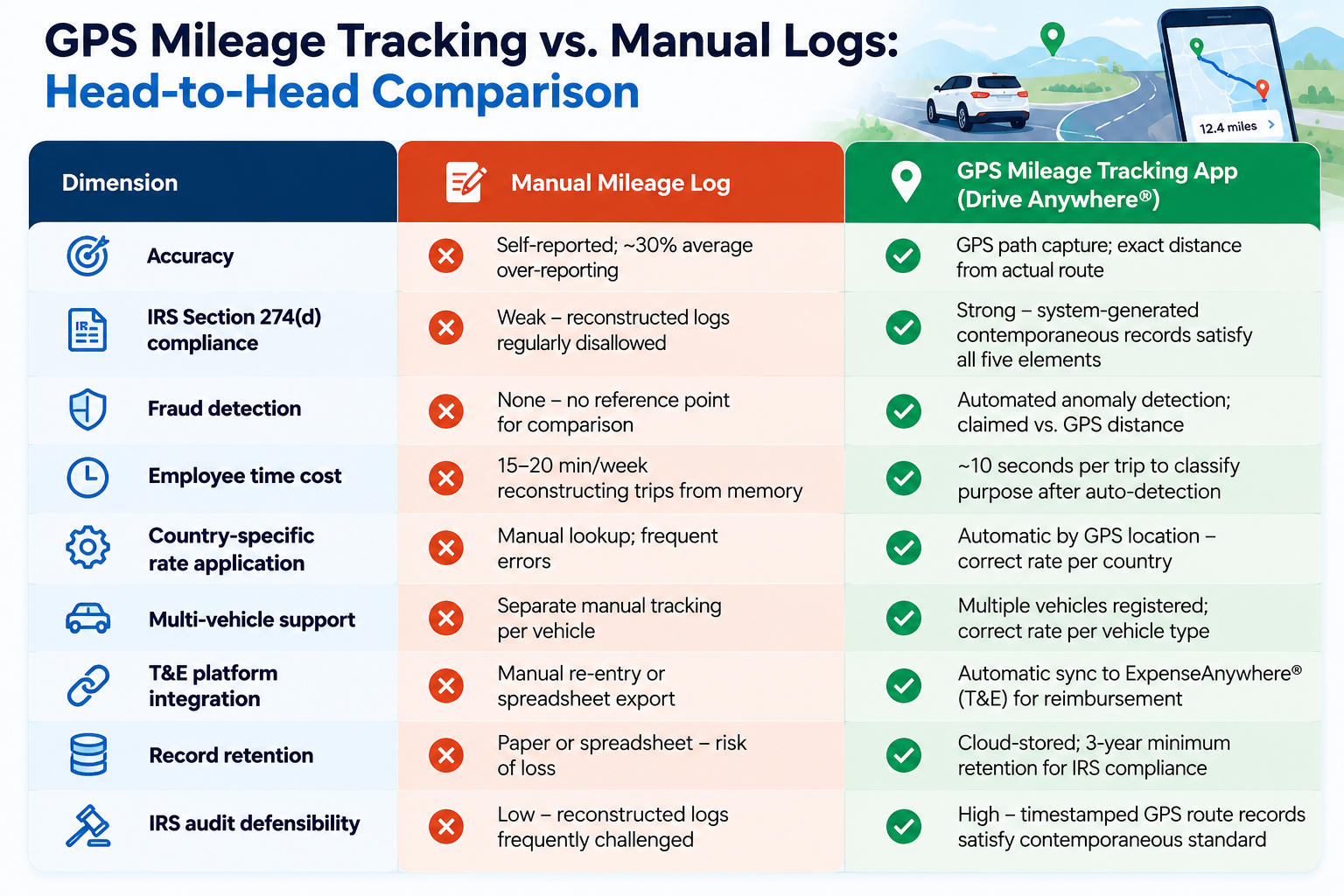
Mileage is the most commonly falsified expense category in companies with mobile workforces. Internal tracking data from GPS mileage platforms shows drivers over-reporting business mileage by an average of nearly 30% when using manual logs, measured by comparing claimed distances against GPS-verified routes for identical trips. A separate survey by GlobalExpense found that 25% of employees fabricate expense claims, with mileage as the most frequently inflated category. Webexpenses research reinforced this: 43% of employees who claim mileage reimbursements admit extending the distances traveled, with many citing the rationalization that “everyone over-claims.”
The reason this fraud persists is structural. A finance manager reviewing a mileage log has no reference point. “Client meeting, 47 miles” could be 47 miles or 62 miles with 15 inflated. Without GPS-verified route data, the verification gap is unbridgeable. A mileage tracker for business that captures the actual path driven eliminates this gap by replacing memory with objective measurement.
IRS Section 274(d): What “Adequate Records” Actually Requires
Under IRS Publication 463 and Internal Revenue Code Section 274(d), every deductible business trip must be documented with five specific elements: the amount of mileage for each trip; the date of travel; the origin and destination; the business purpose; and the business relationship of any passengers. These records must be contemporaneous, i.e., created at or near the time of travel, not reconstructed from memory weeks or months later.
Section 274(d) imposes the strictest substantiation standard in the entire Internal Revenue Code. Unlike most deduction categories, where a court can estimate a reasonable amount even with imperfect records, inadequate mileage records result in complete disallowance with no estimation permitted. The Tax Court has consistently applied this standard, denying vehicle deductions in their entirety when logs were reconstructed from memory or contained inconsistencies with objective records such as calendar entries or client visit schedules.
This creates a specific compliance risk for organizations relying on manual logs. If an employee’s mileage records are later found inadequate, both the employee’s deduction and the employer’s reimbursement treatment may be reclassified as taxable compensation, compounding the error into a payroll tax exposure.
GPS Mileage Tracking vs. Manual Logs: Head-to-Head Comparison
How Drive Anywhere® (Mileage Tracking) Works for Distributed Workforces
Drive Anywhere® is the mileage tracking app from ExpenseAnywhere Corporation, built specifically for distributed workforce use cases like the field sales team covering a three-state territory, the home health nurses making 15 patient visits in a day, the HVAC technicians moving between job sites. The best mileage tracking app for this environment does three things automatically. It detects when a drive starts, captures the full path using GPS, and applies the correct reimbursement rate without the employee doing anything beyond classifying the trip’s purpose.
The automatic trip detection technology in Drive Anywhere® uses GPS and motion sensors to begin recording the moment the vehicle moves, capturing the full path driven rather than only start and end coordinates. This distinction matters, as straight-line point-to-point distance routinely underestimates actual driving distance in urban environments, during traffic diversions, or across multi-stop routes. The GPS path record also satisfies the IRS’s contemporaneous records requirement under Section 274(d), timestamped, GPS-verified, and unalterable after capture.
For multi-country operations, Drive Anywhere® applies country-specific reimbursement rates automatically based on trip location, whether the IRS standard rate of $0.725/mile in the US, HMRC Approved Mileage Allowance Payments in the UK, or applicable rates elsewhere in its coverage map. Trip data syncs directly to ExpenseAnywhere® (T&E) for reimbursement processing without re-entry, completing the touchless loop from automatic trip detection to payroll-ready reimbursement.
The Financial Case: What Accurate Mileage Tracking Saves
For an organization with 50 field employees averaging 800 business miles per month at the 2026 IRS rate of $0.725/mile, total annual mileage reimbursements are approximately $435,000. A 30% over-reporting rate on manual logs represents over $130,000 in annual erroneous payments, not purely from intentional fraud, but because manual logging is structurally inaccurate. A mobile app for tracking mileage with GPS path capture eliminates this overpayment through automated route verification, typically paying for itself within the first quarter of deployment.
The secondary savings are administrative. Each mobile employee spends an estimated 15-20 minutes per week reconstructing mileage logs from memory. For 50 employees at a loaded cost of $35/hour, that is $30,000-$40,000 per year in productive time absorbed by a manual process that a mileage tracker app eliminates entirely.