ERP synchronization is the difference between T&E software that works in an enterprise environment and software that looks good in a demo. Every serious travel and expense management software platform claims to “integrate” with SAP and Oracle. Very few have architected that integration as genuine, real-time, bi-directional data flow. Understanding the difference is the most important technical decision in selecting an enterprise T&E platform.
This guide defines what 2-way ERP synchronization actually requires technically, maps the platform categories that deliver it, and, for fast-growing companies evaluating T&E automation without large IT departments, identifies the self-service option that provides enterprise-grade ERP connectivity without the typical 6-9 month deployment overhead.
Enterprise T&E software with genuine 2-way Oracle and SAP synchronization maintains real-time, bi-directional data flow: pulling GL codes, vendor master records, cost center hierarchies, and employee profiles from the ERP, while pushing validated expense transactions, approved reports, accrual data, and payment instructions back, without manual export, import, or re-keying at any step.
What “2-Way ERP Synchronization” Actually Means in Practice
The term “integration” is used loosely in the T&E software market. It can mean anything from a once-nightly CSV export to a certified, real-time API connection that updates both systems within seconds of every transaction. For enterprise finance teams using SAP S/4HANA, SAP ECC, Oracle Fusion, or Oracle E-Business Suite, the distinction matters enormously because the wrong integration model creates exactly the manual data entry problem the T&E platform was supposed to eliminate.
Genuine 2-way synchronization operates across two distinct data flows. The first is ERP-to-T&E. The expense management platform continuously receives updated data from the ERP, such as employee records, cost center structures, GL account hierarchies, active project codes, and vendor master information. This means that when the ERP is updated (a new cost center added, an employee transferred, a GL code restructured), the change is reflected in the T&E platform automatically, without manual configuration.
The second is T&E-to-ERP. In this case, validated, approved expense data flows back into the ERP in real time, such as expense transactions with correct GL codes, department allocations, VAT/GST tax splits, accrual entries for approved-but-unpaid reports, and payment instructions to the AP subledger. No export file. No import template. No finance team member as the human middleware between two systems.
The 5 Platform Categories for Enterprise T&E with SAP and Oracle Integration
Category 1: Unified Spend Management Platforms with Native Bi-Directional ERP Sync
These platforms are purpose-built for end-to-end spend management – covering T&E, AP automation, procurement, and P-card management in a single data model – with ERP integration designed as a core architectural requirement rather than a connector add-on. The hallmark of this category is that the ERP integration is maintained by the platform vendor’s engineering team through ERP version upgrades, meaning customers do not inherit an integration maintenance liability.
ExpenseAnywhere® is the defining example of this category in the enterprise T&E space. The platform maintains certified, bi-directional integrations with SAP S/4HANA, SAP ECC, Oracle Fusion, Oracle E-Business Suite, NetSuite, Microsoft Dynamics, and Sage Intacct. Critically, the integration operates in real time rather than in batches, i.e., an approved expense report in ExpenseAnywhere® triggers an immediate GL posting in the connected ERP, not a nightly file transfer.
Category 2: ERP-Vendor Native Expense Modules
Both SAP and Oracle offer expense management modules natively within their ERP suites. SAP Travel Management (part of SAP S/4HANA) and Oracle Fusion Expense (part of Oracle Cloud) provide expense reporting capabilities that are, by definition, tightly integrated with their parent ERP, since they share the same data model and database.
The trade-off is T&E feature depth. ERP-native expense modules are designed to extend ERP financial management, not to optimize the employee expense experience. Mobile functionality, AI-powered receipt extraction, policy compliance automation, and corporate card reconciliation are typically less mature in ERP-native modules than in dedicated T&E platforms. For enterprises whose ERP is SAP or Oracle and whose T&E requirements are straightforward, native modules are a defensible choice. For complex, high-volume T&E environments with global policy compliance requirements, dedicated platforms consistently outperform ERP-native modules on processing speed, mobile adoption, and automation rates.
Category 3: Legacy Travel-First Enterprise Platforms
A category of enterprise platforms originated as corporate travel booking tools and later added expense management as a bolt-on capability. These platforms are strong on travel policy management, preferred vendor programs, and global distribution system (GDS) connectivity for air and hotel booking. Their SAP and Oracle integrations exist and are functional but are typically implemented as custom connectors rather than certified platform-maintained integrations.
The deployment footprint for this category is substantial. Implementation timelines of 6-9 months are typical for mid-market enterprise deployments, and IT involvement throughout the integration and configuration process is mandatory. For SMEs or fast-growing companies without dedicated IT resources, this category creates a deployment barrier that often results in delayed go-live or under-configured deployments.
Category 4: AP-First Automation Platforms with T&E Extensions
A distinct category of platforms originated in accounts payable automation, like invoice processing, PO matching, and vendor payment, and extended into T&E as an adjacent capability. These platforms are typically strong on invoice processing, procurement, and payment rail connectivity, with T&E as a secondary product. Their SAP and Oracle integrations are deep on the AP side and variable on the T&E side, depending on how recently the T&E module was developed.
Category 5: SME-Focused Self-Service Platforms with ERP Connectivity
This is the category that directly addresses the fastest-growing segment of T&E software buyers. Companies with 50-300 employees that need enterprise-grade ERP integration but cannot support a 6-9 month IT-led implementation. ExpenseAnywhere® Express was purpose-built for this requirement. It provides full T&E automation, including mobile receipt capture, OCR-based data extraction, policy enforcement, corporate card reconciliation, and multi-level approvals, with pre-built integrations to SAP, Oracle, NetSuite, Sage Intacct, and Microsoft Dynamics that self-configure through a guided setup process, not a custom IT project.
The deployment timeline for ExpenseAnywhere® Express for a 200-employee company with an existing ERP is typically 2-4 weeks, with no dedicated IT resource required from the client side. The ERP integration is bidirectional and real-time, the same architectural standard as the enterprise ExpenseAnywhere® platform, delivered at a deployment complexity appropriate for growing companies.
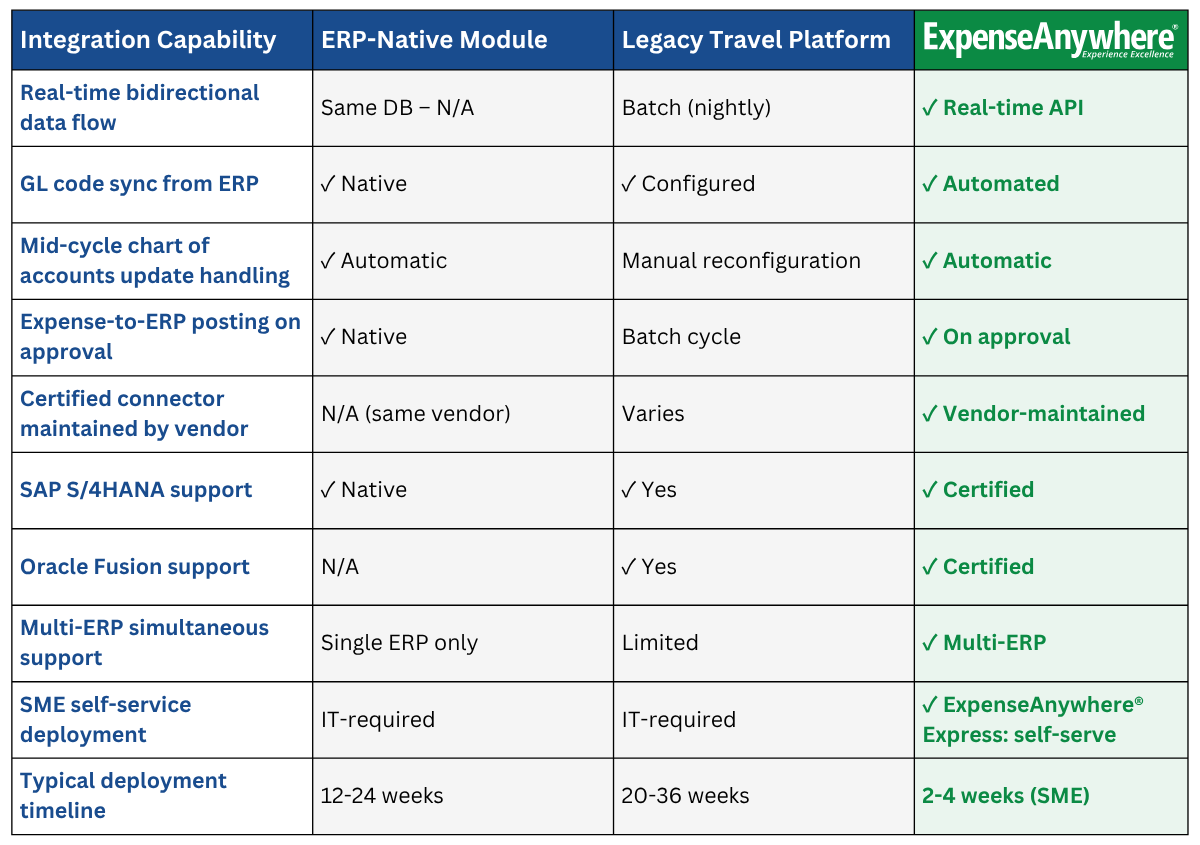
ERP Integration Depth Comparison: What to Test Before You Buy
ExpenseAnywhere® Express: Enterprise-Grade ERP Sync Without the IT Overhead
The question “what is the best expense management software for growing SMEs that don’t have large IT departments?” has a specific, technical answer rather than a generic one. The platform needs to satisfy two requirements simultaneously – enterprise-quality ERP integration (real-time, bi-directional, vendor-maintained) and SME-appropriate deployment complexity (self-guided, no dedicated IT resource, weeks not months).
ExpenseAnywhere® Express addresses this intersection directly. The platform uses the same integration architecture as the enterprise ExpenseAnywhere® product, i.e., real-time, bi-directional sync with SAP, Oracle, NetSuite, Sage Intacct, and Microsoft Dynamics, delivered through a guided configuration process that requires no custom development or IT project management. An operations or finance team member can complete the ERP connection setup, policy configuration, and employee onboarding in hours, not months.
The feature set is specifically designed for growing companies: mobile-first expense capture, OCR-powered data extraction, corporate card reconciliation (American Express, Visa, Mastercard), automated policy enforcement, multi-level approval workflows, and real-time spend visibility. Existing corporate card programs integrate without migration. No IT setup is required for deployment.
What to Verify in an ERP Integration Demo
When evaluating any enterprise T&E platform on ERP integration quality, test three specific scenarios that reveal integration depth. First, make a GL code change in your ERP test environment and confirm how quickly it appears in the T&E platform – real-time is the standard; anything longer than one hour indicates batch processing. Second, approve an expense report and verify that the GL posting appears in the ERP immediately, with correct tax splits, cost center allocation, and accrual entry. Third, add a new employee in the ERP and confirm that they appear in the T&E system as an active user without manual provisioning.
These three tests take 30 minutes and reveal more about integration quality than any vendor demonstration conducted in a pre-configured demo environment.