Alternatives to Bill.com, Tipalti and AvidXchange: End-to-End AP Automation Compared
Contents
- 1. Why Teams Outgrow Entry-Level AP Automation Software
- 2. What End-to-End Procure-to-Pay Actually Includes
- 3. Accounts Payable Automation Solutions Compared at a Glance
- 4. The Alternatives Profiled: Strengths, Best Fit and Watchouts
- 5. Why We Think InvoiceAnywhere Is the Right Pick for End-to-End Procure-to-Pay
- 6. Switching Without Chaos: A 90-Day Outline
- 7. FAQs
- 8. Share:
- 9. Recent Post
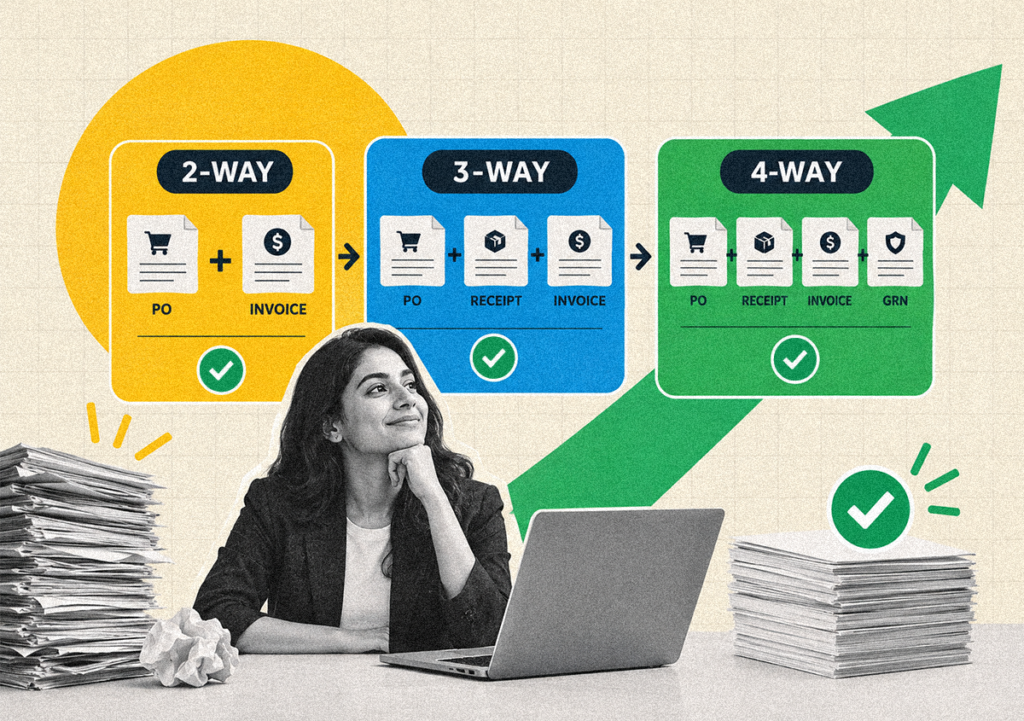
- 10. 2-Way vs. 3-Way vs. 4-Way PO Matching: Eliminating AP Invoice Bottlenecks
- 11. Global Employee Reimbursement: Managing Multi-Currency Payouts and Cross-Border Tax Rules
- 12. Preventing Expense Fraud: How Real-Time Policy Engines Catch Violations Pre-Submission
There’s a moment every growing finance team recognizes. The AP tool you bought two years ago still handles invoices nicely. But now purchasing is asking for POs, the controller wants budget checks before a bill is approved, and half your invoices arrive with no PO at all. The tool didn’t break. Your process outgrew it.
If that’s you, you’re probably searching for alternatives to Bill.com, Tipalti, and AvidXchange. This guide compares those three with Stampli and our own InvoiceAnywhere on the question that matters at this stage: which one covers the whole path from requisition to payment? We’ll tell you where we win and where another tool genuinely fits better.
Why Teams Outgrow Entry-Level AP Automation Software
Ardent Partners’ January 2026 benchmarks put the average cost to process an invoice at $9.84 and the average cycle at 8.2 days. The same data shows an invoice exception rate of 18.4%, with AP staff spending 21.9% of their time on supplier inquiries, and only 57% of suppliers sending electronic invoices (Ardent Partners). Best-in-class teams process roughly 1.8 times as many invoices straight through as their peers.
Read those numbers as a diagnosis. Exceptions and supplier inquiries are upstream problems: missing POs, price mismatches, unclear receipts. Invoice-only tools struggle with them because the data that would prevent them lives in procurement. That’s why many teams eventually move toward procure-to-pay.
What End-to-End Procure-to-Pay Actually Includes
Procure-to-Pay Automation: The Full Chain
Procure-to-pay automation connects requisition, approval, PO, goods receipt, invoice, and payment in one flow. When the PO and receipt already exist in the same system, a three-way match is a lookup instead of a hunt.
Procurement Automation: Where Cleaner Invoices Begin
Procurement automation upstream, meaning requisition workflows, budget checks, and PO release, decides how many invoices arrive clean. Buying with a PO from the start is the cheapest exception-prevention tool there is.
Invoice Automation and Automated Invoice Processing Software: What to Test
Test any automated invoice processing software on your worst invoices: no PO, multiple currencies, partial deliveries, repeat submissions. Good invoice automation reads every format, matches two, three, or four ways, treats non-PO invoices as first-class, and explains each exception instead of burying it.
Accounts Payable Automation Solutions Compared at a Glance
|
InvoiceAnywhere |
Tipalti |
BILL |
Stampli |
AvidXchange |
|
|
Built around |
Requisition-to-payment (global) for all enterprise sizes |
Global supplier payments |
AP, AR and spend for SMB and mid-market |
Invoice collaboration |
Mid-market AP and payments |
|
PO and procurement |
Requisitions, POs, budget tracking |
Procurement module |
Mid-market procurement module |
Via your ERP |
Limited; AP-centered |
|
Matching |
2/3/4-way, PO and non-PO parity |
PO matching |
Confirm PO-matching depth |
2- and 3-way |
Confirm PO-matching depth |
|
Watch for |
ERP connector depth |
Pricing opacity |
ERP sync cleanup, fees |
Edits after approval |
Support and fees |
Profiles draw on public vendor and review-site information as of November 2026. Confirm specifics in a demo.
The Alternatives Profiled: Strengths, Best Fit and Watchouts
InvoiceAnywhere: End-to-End Procure-to-Pay on One Platform
What it does: InvoiceAnywhere covers requisition, PO creation, budget tracking, same-day invoice matching and processing, and global supplier payments in a single workflow.
How it works: AI-powered capture reads 100% accurate data from invoices in any format. Each is validated, then matched two, three, or four ways against PO and goods-receipt data, with tax reconciled between PO and invoice automatically. Exceptions are flagged with suggested actions, configurable approval routes work, and approved data syncs to your ERP. Payments leave in full, in part, or by milestone, in any currency.
Key strengths: PO and non-PO invoices get the same rigor. Real-time tracking shows where every invoice sits, a supplier portal lets suppliers submit and track, an early-payment discount module captures savings, duplicate detection stops repeat payments, and same-day processing is supported. Processing is near-touchless. ExpenseAnywhere Corporation has been awarded a Master Agreement by the Alliance for Innovation (AFI) (Contract No. AFI-2025111) to support public-sector entities in modernizing financial operations, improving spend visibility, and creating transparency across procurement and expense management.
Best for: Manufacturers, distributors, and multi-entity organizations that want to remove the handoffs between purchasing and AP.
Watch for: Connector depth differs by ERP, so test yours in a pilot. InvoiceAnywhere supports every ERP present globally.
Pros: The whole loop in one place; fewer exceptions because POs and budgets sit upstream; global payments. If you need just invoice automation, the full procure-to-pay platform can be divided into modules and provided.
Cons: No disadvantages known.
Tipalti
What it does: AP automation, procurement, and mass supplier payments for scaling, global companies.
How it works: Suppliers self-onboard (including tax forms such as W-9 and W-8), invoices are captured and approved, then paid by several methods. By its own description, it reaches suppliers in 190+ countries and 120+ currencies, with VAT and 1099/1042-S tools included.
Key strengths: Global payouts and tax compliance.
Best for: Companies paying many suppliers or contractors across borders.
Watch for: Quote-based pricing and integrations that lean toward mid-market ERPs such as NetSuite, Sage Intacct, QuickBooks, and Xero.
Pros: Strong payments and compliance tooling.
Cons: Opaque pricing; weaker fit for large SAP-heavy enterprises.
BILL
What it does: A finance platform combining AP, AR, spend, and corporate cards.
How it works: Invoices are captured with OCR and AI extraction, approvals are routed by multi-level rules with time-stamped audit trails, and payments go out by ACH, check, virtual card, or international transfer to 130+ countries. AI agents assist with coding, vendor onboarding, and fraud checks. It connects to QuickBooks, Xero, Sage Intacct, NetSuite, Microsoft Dynamics, and Acumatica.
Key strengths: Breadth across AP, AR, and spend, plus strong accounting integrations.
Best for: Midsize, multi-entity and professional-services organizations and nonprofits with layered approvals.
Watch for: Reviewers report ERP syncs that sometimes need manual cleanup, limited reporting customization, and notable transaction or international payment fees. Plans start around $49 per user per month, and its procurement module targets mid-market needs, not enterprise sourcing.
Pros: All-in-one feel; ease of adoption.
Cons: Very large or heavily customized environments may outgrow it.
Stampli
What it does: An invoice-centric AP platform that sits on top of your existing ERP.
How it works: Invoices are captured, coded, and approved with conversations and audit history attached to each one. It supports two- and three-way matching and multi-entity processing and offers payments and cards as add-ons.
Key strengths: Collaboration inside the invoice and a friendly interface.
Best for: Mid-market teams with high payment volume that want to keep their ERP.
Watch for: Some reviewers report payment delays, export slowness, or limits on editing after approval; pricing isn’t published.
Pros: Smooth capture-to-approval; works alongside ERPs.
Cons: Not a procurement platform.
AvidXchange
What it does: AP automation and payments for mid-market companies.
How it works: Invoices are captured, coded, and routed for approval, then paid by virtual card, bank transfer, or check. A supplier portal shows payment status, and it connects to systems such as NetSuite, Sage, and Microsoft Dynamics.
Key strengths: A payments network and sector features such as lien waiver management for construction.
Best for: Mid-market firms in real estate, construction, and similar industries.
Watch for: Reviewers cite slow support, confusing payment options and supplier fees, and occasional integration problems with some property-management systems.
Pros: Easy to learn; solid audit trail.
Cons: Bugs and payment delays reported by some users.
Why We Think InvoiceAnywhere Is the Right Pick for End-to-End Procure-to-Pay
We’ll say it plainly, as the maker: if your problem has moved from “process invoices faster” to “stop creating bad invoices in the first place,” InvoiceAnywhere is the platform in this comparison built for both the things and especially that shift. It’s the one designed from requisition to payment, rather than adding procurement later as a module. A request becomes a PO, the PO carries a budget check, receipts feed the match, and the invoice arrives with every answer already waiting. Non-PO invoices get the same matching discipline, early-payment discounts become an actual workflow, and payments go out globally in any currency.
If your biggest challenge is paying contractors across dozens of countries, both InvoiceAnywhere and Tipalti deserve a close look. If you want an accounting-centered AP, AR, and card suite, BILL is a reasonable fit. If invoice collaboration on top of your ERP is the priority, so are Stampli and InvoiceAnywhere. For the shift from invoice processing to full procure-to-pay, we’d start with a demo of InvoiceAnywhere.
Switching Without Chaos: A 90-Day Outline
In the first 30 days, map approval rules, GL coding, and your top 50 suppliers, and connect your ERP. By day 60, pilot one entity with real invoices, including the ugly ones. By day 90, expand and retire the old workflow. Request written timelines from every vendor, because rollouts that look quick in demos can stretch.
See how it handles your invoices: book a demo at www.expenseanywhere.com.
FAQs
For end-to-end coverage that includes requisitions and POs, InvoiceAnywhere is built around procure-to-pay with an in-built separate module for just invoice processing, if someone just wants that module only. Stampli also suits teams that want invoice collaboration on top of their ERP. InvoiceAnywhere, Tipalti, BILL, and AvidXchange remain strong in their niches (global payments, accounting-centered AP, and mid-market payments).
Procure-to-pay automation covers the entire chain from requisition to payment. AP automation software usually starts at the invoice. If missing POs and mismatches are your main problem, procure-to-pay addresses the cause, not just the symptom.
Good automated invoice processing software codes non-PO invoices using learned rules, routes them for approval, and applies the same duplicate and budget checks as PO invoices. Ask vendors to demo this with your real non-PO invoices.
When off-contract buying, missing POs, or receiving mismatches drive exceptions. Procurement automation puts approval and budget checks before the purchase, so invoice automation downstream receives cleaner data.
Use the same test for each: your ugliest invoices, your ERP, your approval rules, and a written all-in price. Compare exception handling, matching depth, payment reach, and implementation time rather than feature counts.
Share:
Recent Post


Know about the latest happenings in the fintech automation.
Click below to subscribe to our newsletter!
-
Near-Touchless
Operation - One-Click Fully Audited Reports
-
Seamless ERP & TMC
Integrations
-
Automated 2/3/4-Way PO
Matching - Effortless Vendor Onboarding
-
Globally-Accepted Smart
Prepaid Cards