Imagine hiring a sharp, experienced analyst, handing them a stack of paper invoices, and telling them their only job is to retype numbers into a spreadsheet. All day. Every day. You wouldn’t do it, right?
Yet that is precisely what is happening in accounts payable departments across the globe, right now, at this very moment.
Research from the American Productivity and Quality Center (APQC) reveals a striking pattern: top-quartile AP teams process an invoice for as little as $2.18, while bottom-quartile teams spend over $10 per invoice. The difference is not headcount or industry. It is almost entirely automation. And yet, despite years of available technology, a significant majority of finance teams are still trapped in manual, repetitive workflows that drain resources, breed errors, and leave high-impact work permanently on the back burner.
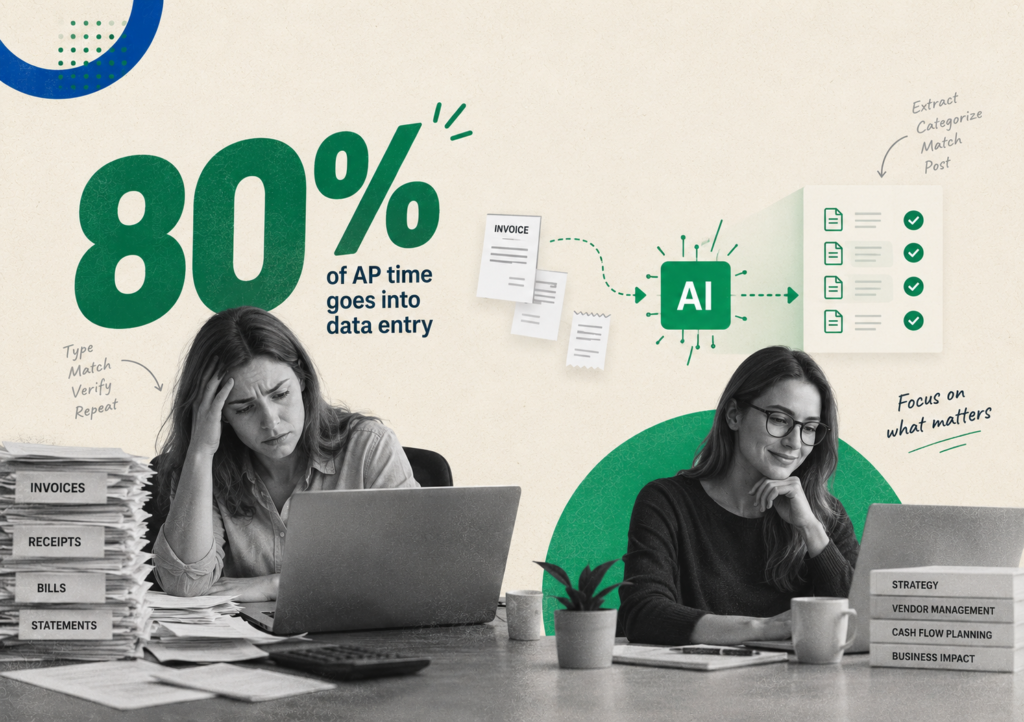
This is what practitioners now call the 80% rule. In most AP functions, without accounts payable automation software, roughly 80% of the team’s time is consumed by low-value data entry tasks, leaving only a fraction of bandwidth for the strategic work that actually moves the business forward. Vendor relationship management, cash-flow forecasting, early-payment discount capture, compliance monitoring — all of it sitting in the queue, waiting for the data entry to stop.
It rarely does. Not without a fundamental shift.
AP teams that automate invoice processing report a 70–80% reduction in manual touchpoints — freeing finance professionals to focus on work that genuinely matters. — Institute of Finance & Management (IOFM), 2024
This article examines why this problem persists, what the data says about its real cost, and how modern accounts payable automation software, including intelligent invoice data capture software with OCR, is finally giving AP teams a way out of the data-entry trap.
The Data Entry Trap: How Did We End Up Here?
Manual Processes Are Still the Norm
If you are reading this and thinking, “Surely most companies have moved past manual data entry by now,” the numbers will surprise you. According to a 2024 Levvel Research report, 49% of organizations still manually key invoice data into their ERP or accounting system. Nearly half. In 2024. And among mid-market companies with revenues between $50 million and $500 million, that figure climbs even higher.
The reasons are understandable. Legacy ERP systems were not built with automated invoice processing in mind. Paper and PDF invoices arrive in dozens of formats. Supplier onboarding is inconsistent. And there is always the familiar refrain heard in every finance leadership meeting: “We have bigger priorities right now.”
But the cost of inaction is compounding quietly.
What “Low-Value” Actually Costs You
Let us put some numbers to this. APQC’s 2024 Open Standards Benchmarking data shows that organizations in the bottom quartile for AP efficiency spend an average of 14 days to process a single invoice end-to-end. Top-quartile organizations? Just 3.4 days. That is a four-times difference in cycle time — and every extra day is a day your working capital is sitting idle, your DPO (days payable outstanding) is drifting, and your supplier relationships are absorbing quiet friction.
The Institute of Finance & Management estimates that invoice exceptions — mismatches, missing PO numbers, incorrect line items — affect between 15% and 25% of all invoices processed manually. Each exception requires human intervention, back-and-forth communication, and often re-entry of corrected data. It is a loop that feeds itself.
And then there is the error rate. Human data entry carries an inherent error rate of 1-3%, according to data science research published in the Journal of Data and Information Quality. That might sound small, but on an AP operation processing 10,000 invoices a month, even a 1% error rate means 100 incorrect entries — each of which has the potential to trigger a duplicate payment, a compliance flag, or an audit finding.
Organizations that eliminate manual data entry through AP automation report a 67% reduction in invoice processing errors and a 60% improvement in on-time payment rates. — Ardent Partners State of ePayables 2024
The 80% Rule, Unpacked
Where AP Time Actually Goes
The term “80% Rule” has become shorthand in AP circles, but it traces back to time-motion studies of finance operations, including research by the Aberdeen Group and IOFM, which consistently found that in non-automated AP environments, the bulk of staff hours are consumed by four activities:
- Manual data extraction from paper, PDF, and emailed invoices
- Re-keying extracted data into ERP or accounting software
- Chasing approvers for sign-off on routine invoices
- Resolving exceptions caused by the errors introduced in the steps above
That is a self-reinforcing cycle of low-value work. And the cruel irony is that it crowds out the high-value tasks: contract compliance reviews, supplier performance analysis, cash-flow optimization, and early-payment discount programs that can generate 1-3% annualized returns on captured discounts, which, as the Association for Financial Professionals notes, can outperform short-term investment yields in many rate environments.
The Hidden Talent Cost
There is also a talent dimension that rarely makes it into ROI spreadsheets. A 2023 Deloitte CFO Survey found that finance leaders rank talent retention as a top-three challenge. What does it say to a skilled finance professional that their primary function is re-keying invoice data? Turnover in AP roles is high, and recruiting and onboarding costs for finance staff are substantial — anywhere from 50% to 150% of annual salary, according to SHRM’s benchmarks.
In a market where finance talent is in short supply, and employees expect purposeful work, using human intelligence for robotic tasks is not just operationally wasteful. It is a retention risk.
Breaking the Cycle: What AP Automation Actually Does
Intelligent Invoice Data Capture with OCR
Modern automated invoice processing starts at the point of ingestion. Invoice data capture software with OCR (Optical Character Recognition) technology reads incoming invoices, whether they arrive as scanned paper, PDF, EDI, or email attachments, and extracts structured data without a human ever touching a keyboard.
But the important distinction between today’s intelligent OCR and the first-generation OCR tools of a decade ago is machine learning. Older OCR simply read text. Modern invoice data capture software learns. It recognizes vendor-specific invoice formats, improves its accuracy the more invoices it processes from a given supplier, and flags anomalies it has learned to associate with errors or fraud. According to a 2024 Gartner report on intelligent document processing, best-in-class platforms now achieve extraction accuracy rates of 95-99% across diverse invoice formats, far exceeding human accuracy at scale.
The output is structured, validated data that flows directly into your ERP or AP workflow. No re-keying. No transcription errors. No bottleneck.
Three-Way Matching Without the Headache
One of the most labor-intensive parts of traditional AP is three-way matching: confirming that a supplier invoice aligns with the original purchase order and the goods receipt. When done manually, this process involves opening three separate records, cross-checking line items, quantities, and unit prices, and documenting any discrepancies. In high-volume environments, it is exhausting and error-prone.
Accounts payable automation software performs three-way matching automatically, in real time, at the point of invoice receipt. Matched invoices route directly to payment queuing. Exceptions, and only exceptions, are flagged for human review. The AP team’s attention becomes genuinely selective rather than uniformly reactive.
IOFM data from 2024 shows that organizations using automated three-way matching reduce exception rates by up to 60% compared to manual operations, because the discipline of structured data capture upstream prevents the mismatches that cause exceptions in the first place.
Touchless Processing: The Goal Worth Pursuing
The ultimate benchmark in AP automation is touchless invoice processing — invoices that go from receipt to payment approval with zero human intervention. According to Ardent Partners’ 2024 ePayables research, best-in-class AP organizations achieve touchless processing rates of over 70%. The industry average remains below 30%. That gap represents an enormous opportunity.
Getting to high touchless rates requires a combination of intelligent invoice data capture, automated matching, configurable approval workflows, and clean master data (accurate vendor records, PO data, and GL coding rules). But for organizations that invest in this infrastructure, the AP automation benefits are quantifiable and fast to materialize: lower cost-per-invoice, faster cycle times, fewer errors, and finance teams redeployed to work that creates real value.
The AP Automation Benefits You Cannot Afford to Ignore
Cost Reduction at Scale
The APQC data is unambiguous. Top-performing AP organizations, those that have fully embraced automation, process invoices for a fraction of what laggards spend. When you multiply even a $5 difference in cost-per-invoice across 100,000 annual invoices, you are looking at $500,000 in direct savings. For large enterprises processing millions of invoices annually, the math becomes transformational.
And that is before accounting for early-payment discounts. A 2/10 net 30 discount (2% off for paying within 10 days) represents a 36.7% annualized return. Most organizations cannot capture these discounts because their manual AP cycle takes 14+ days just to approve an invoice. Automation compresses that cycle to days, sometimes hours, making discount capture reliably achievable.
Compliance and Audit Readiness
Manual AP is a compliance liability. Approvals documented in email threads, data scattered across spreadsheets, and paper invoices filed in binders do not provide the audit trail that regulators and auditors expect. A 2024 PwC Global Economic Crime Survey found that billing fraud, often enabled by weak AP controls, remains one of the top three forms of occupational fraud in organizations.
Accounts payable automation software creates an immutable digital audit trail for every invoice. Approval timestamps, user actions, matching results, and exception resolutions are all captured automatically. When an auditor asks for documentation, you export a report. When a vendor disputes a payment, you pull the complete workflow history in seconds. Compliance stops being a fire drill and becomes a standard output of normal operations.
Scalability Without Proportional Headcount
Perhaps the most strategically valuable AP automation benefit is scalability. As a business grows through organic expansion, acquisitions, or new vendor relationships, the volume of invoices grows with it. Under a manual model, growth in invoice volume directly requires growth in AP headcount. It is a linear, expensive relationship.
With automation, that relationship breaks. Processing twice the invoices does not require twice the staff. It may require negligible additional resources. Aberdeen Group research consistently finds that top AP teams handle significantly more invoices per FTE than their peers, not because they work harder, but because software handles the repetitive work that used to consume most of the day.
Conclusion: Stop Paying Skilled People to Do Robotic Work
The 80% rule is not a permanent law of finance. It is a symptom of underinvestment in technology, resistance to change, and a quiet organizational acceptance that AP is meant to be painful.
It does not have to be.
Accounts payable automation software has matured to the point where implementation is faster, ROI is demonstrable, and the risk of inaction now outweighs the risk of change. Invoice data capture software with OCR eliminates manual data entry at the source. Automated matching and intelligent workflow routing eliminate the bottlenecks downstream. The net result is an AP function that is faster, more accurate, more compliant, and staffed with professionals doing work that genuinely demands human judgment.
The organizations winning on cost efficiency, supplier relationships, and financial visibility in 2025 are not the ones with the biggest AP teams. They are the ones that made the decision to eliminate manual data entry, and never looked back.
At ExpenseAnywhere, we built our AP automation platform on a simple conviction: your finance team is too valuable to spend their day typing. From intelligent invoice capture to end-to-end automated processing, we help organizations break the 80% Rule and unlock the AP function they always should have had.
FAQs
Accounts payable automation software digitizes and streamlines the entire invoice lifecycle — from receipt and data extraction through PO-matching, approval, and payment. It uses technologies like OCR, machine learning, and workflow automation to process invoices with minimal or zero manual intervention. The result is faster cycle times, fewer errors, lower cost-per-invoice, and a complete digital audit trail for every transaction.
Invoice data capture software with OCR reads incoming invoices in any format, like scanned paper, PDF, email attachment, or EDI, and automatically extracts key fields such as vendor name, invoice number, date, line items, amounts, and tax data. Modern platforms use machine learning to improve extraction accuracy over time, achieving 95-99% accuracy on diverse invoice formats. The captured data flows directly into your ERP or AP system, removing the need for a human to re-key anything.
For mid-market organizations, the core AP automation benefits include: a dramatic reduction in cost-per-invoice (often from $8-$12 to under $3), faster invoice cycle times that enable early-payment discount capture, significantly lower error and exception rates, improved compliance with a full digital audit trail, and the ability to scale AP operations without adding proportional headcount. Many mid-market companies also cite better supplier relationships and improved cash-flow visibility as unexpected but highly valued outcomes.
Implementation timelines vary by organization complexity, but modern cloud-based automated invoice processing platforms can go live in as little as 4-8 weeks for mid-market organizations with relatively standardized AP workflows. Full optimization, including high touchless processing rates and deep ERP integration, typically takes 3-6 months as the system learns vendor invoice formats and master data is cleansed. The key success factor is stakeholder alignment and data readiness before go-live, not software complexity.
AP automation delivers strong ROI across organization sizes. While large enterprises benefit from automation at high invoice volumes, smaller businesses often see proportionally larger impact because every invoice processed manually represents a higher percentage of limited finance staff capacity. Cloud-based accounts payable automation software has made enterprise-grade capabilities accessible to companies of all sizes, with subscription pricing models that tie cost to volume rather than requiring large upfront investments. Even organizations processing a few hundred invoices per month can justify automation when the full cost of manual processing — labor, errors, missed discounts, and audit risk — is accounted for.