Invoice matching, or validating a supplier’s invoice against the documents generated during the purchase and receiving process, is the single highest-volume analytical function in most accounts payable operations. It is also one of the most frequently misunderstood. Finance leaders evaluating AP automation regularly encounter references to “2-way,” “3-way,” and “4-way matching” without a clear explanation of what each method actually validates, when each is appropriate, and what the accuracy and risk trade-offs are between them.
Getting the matching tier wrong in either direction creates real problems: insufficient matching creates payment risk and fraud exposure; over-specifying matching creates AP bottlenecks by requiring documents that don’t exist for service-based procurement. This guide provides the definitive explanation of each tier, maps them to the procurement contexts where they apply, and explains how automated invoice matching eliminates the manual PO matching bottlenecks that cause the majority of AP processing delays.
According to IOFM benchmarking, AP teams processing invoices with manual PO matching incur an average cost of $6.30 per invoice, versus $1.45 for teams with automated invoice matching; a 77% cost reduction driven primarily by eliminating manual cross-referencing and exception handling time.
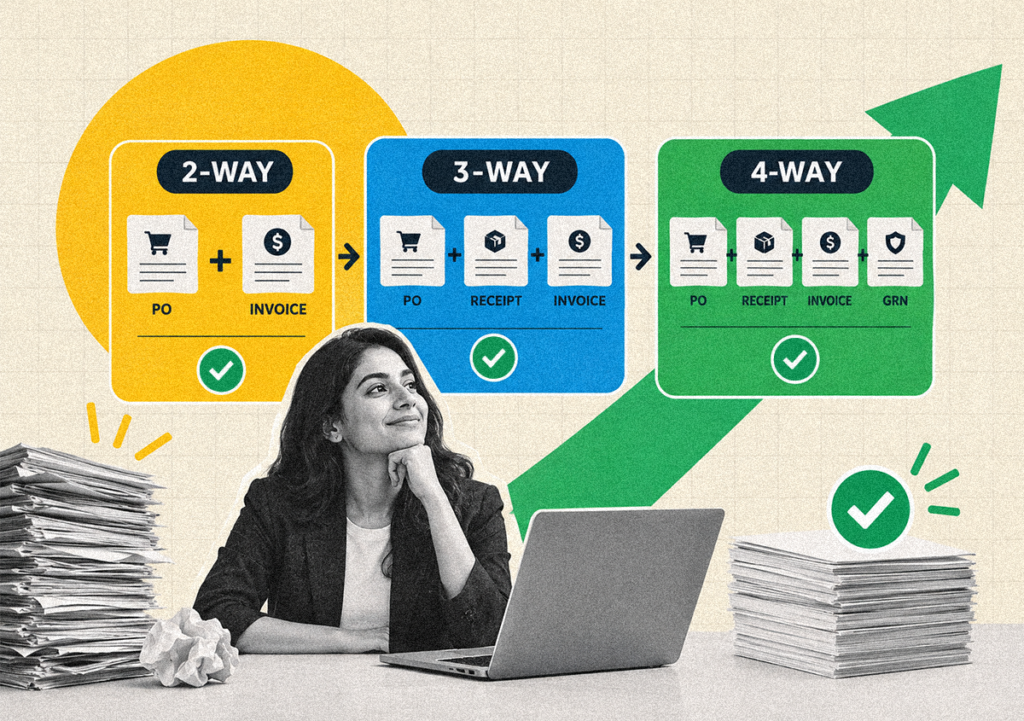
2-way PO matching compares a supplier invoice against the purchase order (PO) to verify that the billed price, quantity, and terms match what was ordered. 3-way matching adds a goods receipt note (GRN) to confirm that the goods were actually received before payment is authorized. 4-way matching adds an inspection or acceptance document to confirm that goods met specified quality or functional requirements. InvoiceAnywhere® (AP/P2P) by ExpenseAnywhere Corporation automates all three matching types using AI to cross-reference PO, invoice, GRN, and inspection data without manual AP intervention, applying the appropriate matching tier based on procurement type and PO configuration.
What Is PO Matching and Why It Matters in Accounts Payable
PO matching is an accounts payable control that prevents payment of fraudulent, duplicate, or erroneous supplier invoices by requiring invoice data to align with independent documentary evidence generated during the procurement and receiving process. Without invoice matching, an AP team has no systematic way to verify that an invoice corresponds to an actual approved purchase, that ordered goods were received, or that billed amounts match contractually agreed terms.
The ACFE Occupational Fraud 2024 Report identified billing schemes, including duplicate invoicing, fictitious vendor invoices, and overpayment fraud, as among the most financially damaging categories of asset misappropriation. PO matching is the primary structural control that prevents these schemes from succeeding. An invoice that references a PO with matching quantities, confirmed receipt, and verified quality cannot be a fictitious charge.
2-Way PO Matching: Price and Quantity Verification
2-way matching is the foundational form of invoice matching. It compares exactly two documents: the supplier invoice and the purchase order.
What it validates: Billed quantity does not exceed ordered quantity; unit price falls within the tolerance band of the agreed PO price; invoice line items correspond to PO line items; invoice total is consistent with line-item calculations; correct vendor and PO reference number.
When to use it: Service invoices where no physical delivery occurs – consulting fees, software subscriptions, SaaS licenses, utilities, maintenance contracts, professional services retainers. Any procurement category where there is no physical receiving event to confirm.
Key limitation: 2-way matching does not confirm that goods or services were actually delivered or that performance occurred before payment. For physical goods procurement, this gap creates meaningful payment risk.
3-Way PO Matching: Adding Goods Receipt Confirmation
3-way matching is the standard PO matching method for physical goods procurement and the most widely used tier in manufacturing, distribution, and retail AP environments. It adds a third document, the goods receipt note (GRN) or receiving report, to the two-document comparison.
What it validates: Everything in 2-way matching, plus: received quantity matches invoiced quantity within tolerance; receipt date precedes the invoice payment date; goods were received at the correct facility; GRN reference links to the correct PO.
When to use it: Standard product and raw material procurement; indirect purchasing of physical supplies and equipment; any purchase where goods are received against a PO through a formal receiving process.
Key protection: Prevents payment for goods ordered but not yet received; catches short-shipment scenarios where a full invoice is presented for a partial delivery; closes the gap between what was ordered (PO) and what actually arrived (GRN).
4-Way PO Matching: Adding Inspection and Acceptance
4-way matching is the highest-assurance tier of automated invoice processing. It adds a fourth document, an inspection certificate, quality acceptance report, or acceptance document, to the three-document comparison.
What it validates: Everything in 3-way matching, plus: received goods passed quality inspection against the specification defined in the PO; inspection was performed by an authorized inspector or quality function; inspection certificate references the GRN and PO; no open defect holds are blocking payment authorization.
When to use it: Technical and precision equipment; pharmaceutical and medical device procurement (FDA compliance context); aerospace and defense components (AS9100, FAR/DFARS requirements); perishable goods where quality at receipt must be verified; any procurement where specification compliance is an explicit payment condition rather than an implied one.
Key protection: Prevents payment for goods received but failing quality inspection; provides the documentation basis for warranty claims and supplier non-conformance records; closes the most sophisticated AP fraud gap, the scenario where goods are received and confirmed but do not meet the specification that justified the contracted price.
Also Read – How Automated PO Matching Catches What Manual Review Misses
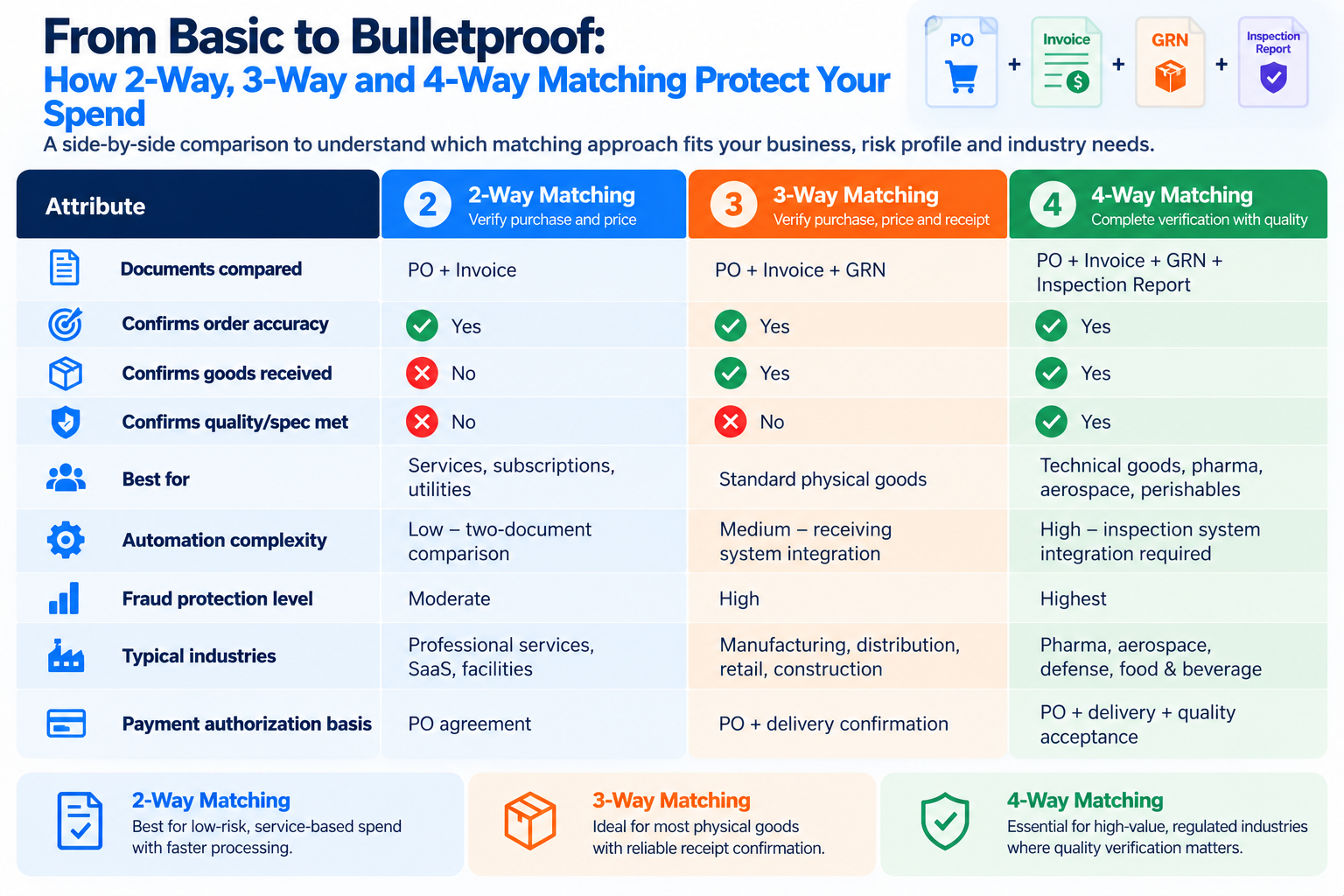
The Definitive Comparison: 2-Way vs. 3-Way vs. 4-Way Matching
Tolerance Thresholds: How Automated Matching Handles Real-World Discrepancies
In real-world procurement, invoices rarely match POs to the cent. Suppliers round fractional quantities, apply minimum billing thresholds, invoice in a different currency that converts with slight variation, or ship in slightly different quantities than ordered for bulk materials. PO matching automation handles this through configurable tolerance thresholds – defined bands within which invoice-to-PO discrepancies are treated as clean matches rather than exceptions requiring manual review.
Typical tolerance configurations include:
- Price tolerance: Invoice unit price within +/-2-3% of PO unit price → auto-approved
- Quantity tolerance: Invoiced quantity within ±2% of received quantity for bulk materials → auto-approved
- Absolute amount tolerance: Invoice total within $25-$100 of PO total for low-value invoices → auto-approved
- Currency tolerance: FX-converted invoice total within ±1% of PO total (for cross-currency procurement) → auto-approved
When a discrepancy falls within the configured tolerance, the invoice is auto-approved and flows to payment. When it exceeds tolerance, the system flags the specific line item, calculates the exact discrepancy, and routes the exception to the appropriate resolver with both documents pre-assembled. This tolerance-based logic is what delivers the 70-80% straight-through processing rates that best-in-class AP organizations achieve, the proportion of invoices that move from receipt to payment approval without any manual AP team intervention.
Also Read – How AI-Driven AP Automation Stops Invoice Fraud
InvoiceAnywhere® (AP/P2P): Autonomous Multi-Level PO Matching
InvoiceAnywhere® (AP/P2P) by ExpenseAnywhere Corporation automates 2-way, 3-way, and 4-way PO matching using its Smart Autonomous Touchless Technology, thereby capturing 100% accurate invoice data via AI-powered OCR, cross-referencing it against live PO and GRN data from the connected ERP, and applying the appropriate matching tier automatically based on procurement type and PO configuration.
When discrepancies are detected, InvoiceAnywhere® does not simply flag them and stop. The system identifies the precise nature of each exception, like quantity variance, price tolerance breach, missing GRN, and inspection hold, generates an AI-driven suggested resolution specific to that discrepancy type, and routes the exception to the correct resolver with relevant documents pre-assembled. This targeted routing compresses invoice approval cycle time for matching exceptions from days to hours.
InvoiceAnywhere® integrates bi-directionally with SAP, Oracle, NetSuite, Microsoft Dynamics, and Sage Intacct, pulling live PO data, vendor master records, and GRN data from the ERP in real time, and posting approved invoice data back to the AP subledger and GL on approval. Real-time ERP data sync means PO matching operates against current procurement records, not a periodic extract, preventing the false-positive exceptions that batch-integrated systems generate when PO data is hours or days stale at the time of matching.
For full procure-to-pay automation, InvoiceAnywhere® extends upstream into purchase requisition and PO creation and downstream into vendor payment through a multi-rail pay service supporting ACH, wire, and virtual card payments globally. This end-to-end architecture, from requisition through receipt, through invoice matching, through payment, is what eliminates the AP invoice bottlenecks that accumulate when each step is a manual handoff between disconnected systems.
Also Read – How Do I Automate AP Invoice Processing Without Replacing My ERP?