
Reimbursing an employee for a domestic business trip takes minutes on a well-automated platform. Reimbursing the same employee for a trip to Singapore, where they incurred expenses in Singapore dollars, paid a client dinner inclusive of GST, received a FOREX advance in USD before departure, and are now waiting for reimbursement in their home currency of Indian rupees, is a different operation entirely. Most expense management software handles the first scenario. Very few are designed to handle the second at enterprise scale.
For global organizations managing distributed workforces across multiple countries, employee expense reimbursements are simultaneously a finance process, a regulatory compliance obligation, a foreign exchange management problem, and an employee experience touchpoint. Getting any one of these wrong creates cascading problems: inaccurate GL postings, missed VAT recovery windows, FOREX reconciliation discrepancies, and, most immediately felt, employees in high-mobility markets waiting weeks to be reimbursed for out-of-pocket costs that ran into thousands.
Global companies pay employee travel reimbursements in local currencies by deploying an expense management platform that tracks three distinct currency layers per transaction: the expense currency (where costs were incurred), the company’s functional accounting currency, and the employee’s reimbursement currency. ExpenseAnywhere® (T&E) by ExpenseAnywhere Corporation manages all three layers autonomously, executes direct employee payments in local currencies across 150+ countries through its built-in Global Pay Service, and tracks FOREX advance conversion rates from issuance through final reconciliation, without routing payments through payroll or requiring a separate cross-border payment service.
The Three-Currency Problem That Manual Processes Cannot Solve
Most spend management software is built around a single functional currency. The company reports in USD, employees are reimbursed in USD, and foreign currency expenses are converted at whatever rate the system applies at reconciliation time. For a single-country organization, this works. For a global organization with employees in 20 countries, this architecture generates three systematic problems that compound month over month.
The first is expense currency capture. An employee in Germany incurs a €450 client entertainment expense. If the system records this as $490 USD at the reconciliation rate rather than the transaction date rate, the GL posting is inaccurate for accounting purposes and non-compliant for VAT reclaim documentation, which requires the original currency amount and the rate applicable on the specific transaction date. The difference seems small on one expense. Across 500 monthly cross-border transactions, it materially distorts financial statements and kills VAT recovery eligibility.
The second is FOREX advance reconciliation. Many global organizations issue FOREX advances to employees travelling to countries where corporate card acceptance is unreliable. The exchange rate when the advance is issued rarely matches the rate when the employee returns and reconciles. Without a system tracking both rates and calculating the exact gain or loss on the advance, FOREX reconciliation is a manual calculation that most finance teams perform inconsistently, creating running discrepancies that surface as unexplained variances at year-end.
The third is reimbursement currency mismatch. An employee based in Singapore who incurs expenses during a business trip to India should be reimbursed in Singapore dollars, not Indian rupees or USD. Executing that correctly requires knowing the employee’s designated reimbursement currency and accessing a payment rail that can deliver cross-border payment in that currency. Without it, employees absorb a personal foreign exchange cost on every international trip, a friction that accumulates into measurable retention risk in high-mobility markets.
Cross-Border Tax Rules That Affect Employee Expense Reimbursements
Beyond currency management, global employee expense reimbursements generate tax compliance obligations that vary substantially by country and expense category. Finance teams managing cross-border reimbursements need to account for at least four distinct frameworks:
VAT input tax recovery (EU): Employees incurring VAT-inclusive expenses in EU member states may entitle the employer to recover input VAT but only if the original receipt meets that country’s specific documentation requirements and the claim is filed within the applicable limitation period. Recovery documentation standards vary meaningfully by member state, and missed windows result in permanent revenue loss.
GST input tax credits (India, Australia, Singapore): GST-registered businesses can claim input credits on eligible employee expenses, provided receipts meet local GST documentation standards and expenses fall within claimable categories. India’s GST framework in particular has specific invoice format requirements that determine whether an input credit claim is valid.
Benefit-in-kind taxation: In most jurisdictions, personal benefits paid through expense accounts, like non-business meal extensions, personal travel portions, and accommodation above the applicable per diem, are subject to benefit-in-kind income tax and employer payroll tax obligations. Without automated policy enforcement at submission, these taxable benefits flow through the expense system uncaptured.
Withholding tax on cross-border payments: In certain countries, cross-border expense reimbursements made to non-resident employees may carry withholding tax obligations that the paying entity must manage and remit. The threshold and rate vary by country pair and by the nature of the underlying expense.
Also Read – How to Automate Mileage Reimbursement for Field Employees?
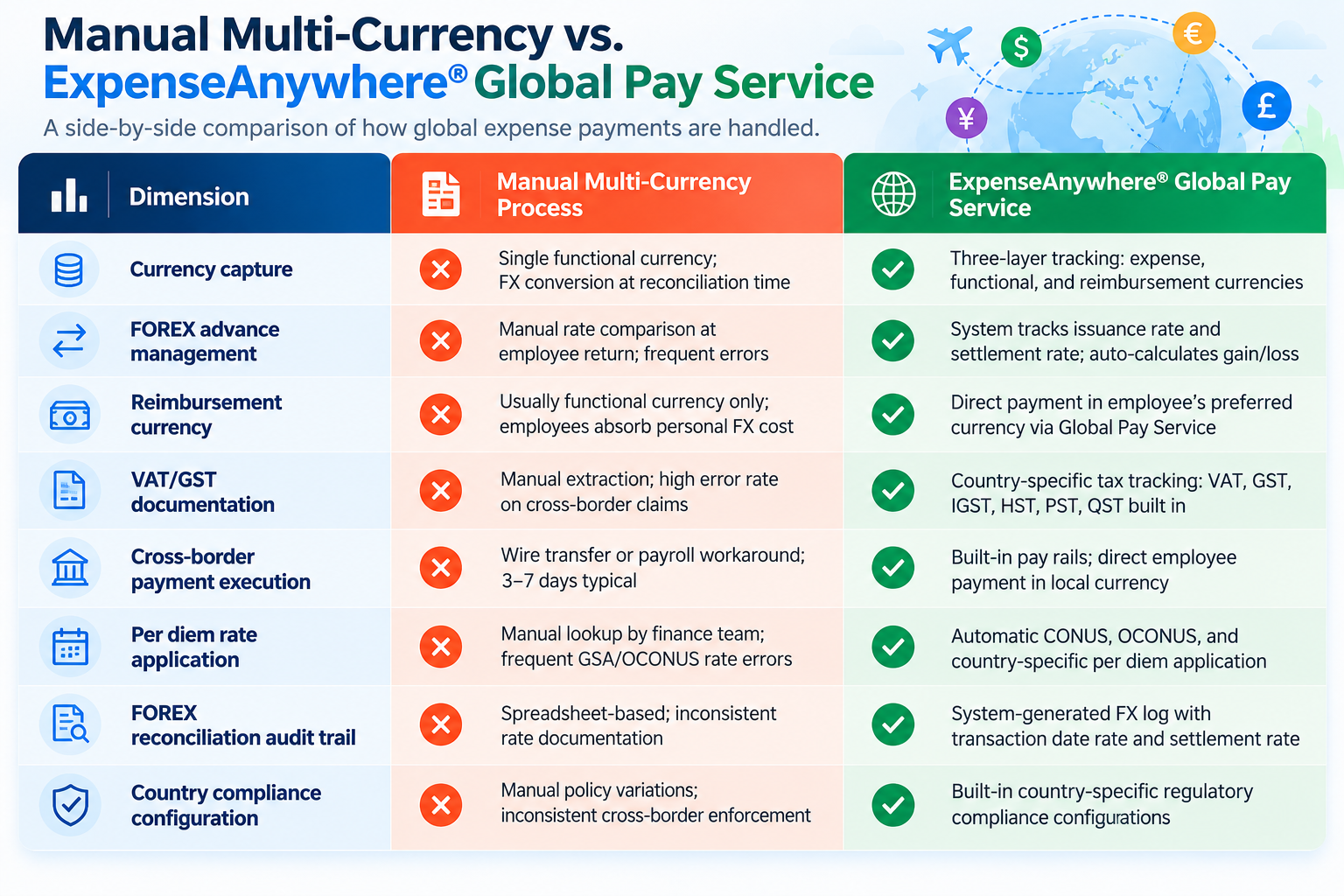
Manual vs. Automated Global Employee Reimbursement: A Comparison
ExpenseAnywhere® (T&E): The Global Pay Service
ExpenseAnywhere® (T&E) by ExpenseAnywhere Corporation includes a built-in Global Pay Service that executes direct employee expense reimbursements in employees’ preferred currencies across 150+ countries, without routing payments through payroll or requiring third-party payment infrastructure. The platform manages the complete multi-currency lifecycle: capturing expenses in the transaction currency, converting to the company’s functional currency for accounting, and executing reimbursement in the employee’s designated currency using the applicable exchange rate.
For FOREX advance management, ExpenseAnywhere® tracks the exchange rate at advance issuance and the rate at final reconciliation, automatically calculating the FOREX gain or loss and posting it to the appropriate GL account. This eliminates the manual reconciliation exercise that typically consumes days of finance team time after multi-country business trips.
Country-specific tax tracking is built in natively across all supported markets: the system captures VAT, GST, IGST, HST, PST, and QST at the transaction level, generating the documentation required for input tax recovery claims in each applicable jurisdiction. A comprehensive tax reclamation service evaluates eligible cross-border expenses and supports recovery of paid taxes, a material financial benefit for organizations with significant international T&E volume, where unrecovered VAT alone can represent hundreds of thousands of dollars annually.
The platform supports all currencies, languages, date formats, and time zones. Every configuration, like per diem rates, country-specific tax frameworks, booking policy rules, and reimbursement currency settings, is maintained within the same architecture that handles domestic expense management, eliminating the parallel processes and reconciliation overhead that organizations typically build to manage their international and domestic T&E separately.
Why Reimbursement Speed Is an Employee Retention Variable
For global organizations competing for field talent across multiple markets, the speed and accuracy of expense reimbursement is an employee experience metric with measurable retention implications. A field sales representative in Singapore who submits a report and receives reimbursement in Singapore dollars within two business days has a materially different experience than one waiting three weeks for a USD wire they then convert at personal expense.
A 2022 Webexpenses survey found that slow expense reimbursements negatively impacted motivation for one in three travelling employees. That ratio is higher in markets where employees are less likely to carry sufficient personal financial reserves to bridge reimbursement gaps of two to three weeks across high-cost business trips.
Building the business case for global expense management software with direct local-currency reimbursement should therefore incorporate both the compliance cost savings and the retention value of removing financial friction from the employee travel experience.