The enterprise travel and expense management software market in 2026-2027 is more differentiated than ever, and the differentiation that matters most is not on the features page. It is in three architectural decisions that determine whether a platform delivers genuine automation in your environment. And these are: how the ERP integration actually works, when policy is enforced, and what automation rate the platform achieves for standard expenses in production, not in a demo.
This guide compares five enterprise T&E platform categories on the dimensions that matter for enterprise deployments, like ERP integration depth, compliance coverage, automation rate, and implementation complexity, so you can evaluate platforms against your actual requirements rather than a generalized feature checklist.
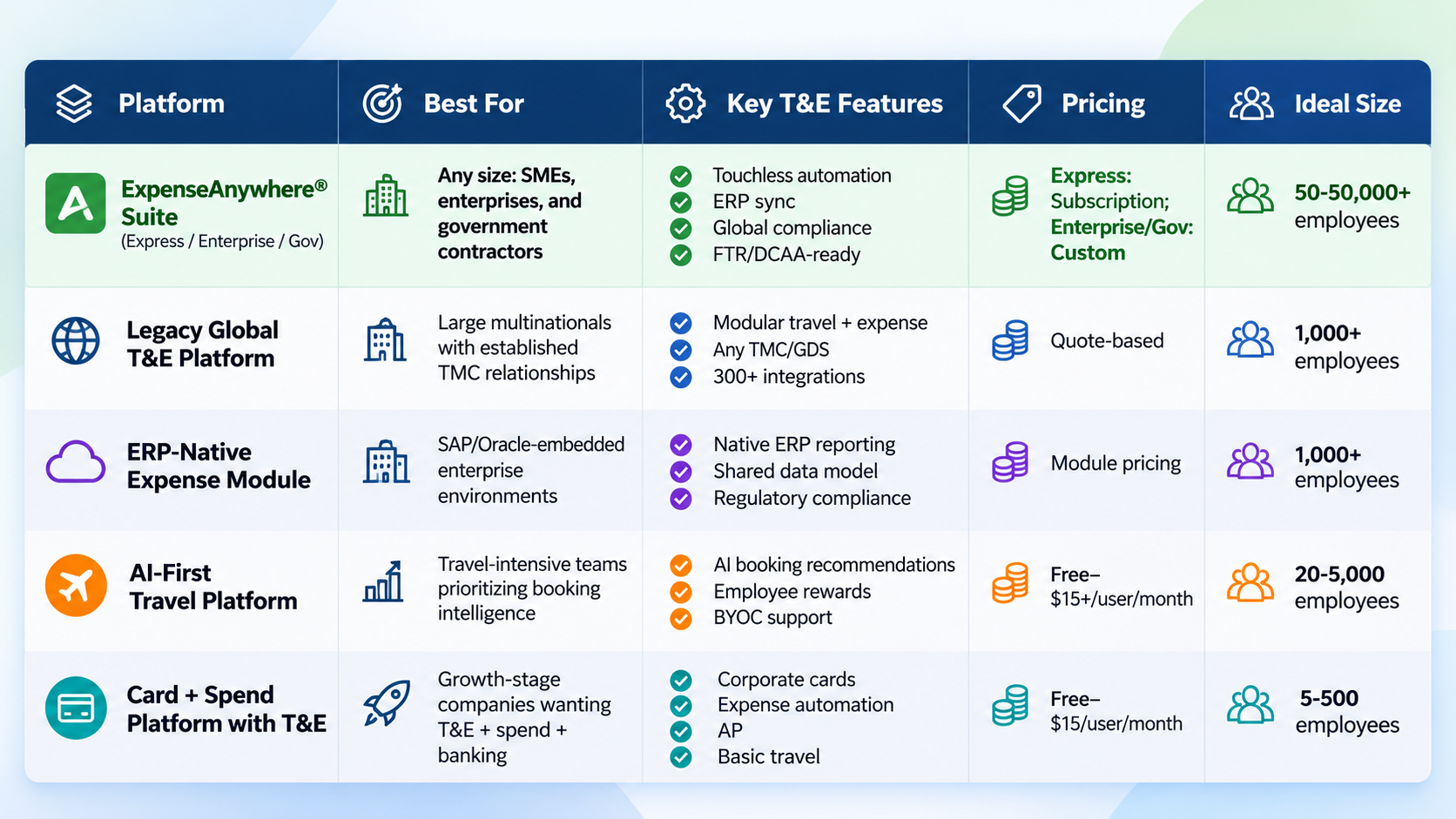
At-a-Glance: Enterprise T&E Software Comparison for 2026
How We Evaluated the Best Enterprise Expense Management Software
Enterprise T&E evaluation requires harder questions than SMB software selection. We assessed each platform category on six dimensions:
- Touchless automation rate: The percentage of standard expense reports that move from receipt capture to ERP posting without any manual human intervention
- ERP integration architecture: Real-time bidirectional and vendor-maintained vs. batch-based and customer-maintained
- Policy enforcement timing: Pre-submission (blocks violations) vs. post-submission (flags them after approval)
- Global compliance: Multi-currency, multi-language, country-specific per diem and tax, plus regulatory framework support (FTR, DCAA, GDPR, HIPAA)
- Implementation complexity: Realistic timeline and IT resource requirement for enterprise-scale deployment
- Scalability: Does the platform serve SME, enterprise, and specialized deployments (government) within the same product architecture?
The Best Enterprise T&E Software Platforms for 2026-2027
1. ExpenseAnywhere® Software Suite – Best for SMEs, Global Enterprises, and Government Contractors
Best for: Organizations at any scale – from growing SMEs to global enterprises to government contractors that want touchless T&E automation with real-time ERP integration and purpose-built compliance for their specific operational context.
ExpenseAnywhere® is available in three configurations that share the same core platform architecture and automation engine, allowing organizations to start at an appropriate scale and grow within the same platform without migrating to a new system.
ExpenseAnywhere Express® – For SMEs and Growing Mid-Market Companies
Designed for companies with 50-300 employees that need enterprise-grade T&E automation without the IT overhead of an enterprise implementation. ExpenseAnywhere® Express provides the full automation capability of the core platform, like AI-powered receipt extraction, policy enforcement, corporate card reconciliation, and real-time ERP integration, through a guided self-configuration process. Standard deployment is 2-6 weeks with no dedicated IT resource required from the client side. As the company grows, it can expand to the Enterprise configuration within the same platform, eliminating the data migration and switching costs typical of platform upgrades.
ExpenseAnywhere® Enterprise – For Large and Global Enterprises
The full enterprise configuration covers the complete T&E lifecycle at scale, i.e., pre-trip approval and travel booking integration, AI-powered receipt capture with OCR extraction with 100% accuracy, Smart Autonomous Touchless Technology for zero-step standard expense processing, corporate card reconciliation across American Express, Visa, and Mastercard programs, multi-entity and multi-currency management with FOREX advance tracking, real-time bidirectional ERP sync with SAP S/4HANA, SAP ECC, Oracle Fusion, Oracle E-Business Suite, NetSuite, Microsoft Dynamics, and Sage Intacct, and country-specific tax tracking (VAT, GST, IGST, HST, PST, QST). The platform is SOC 2, PCI-DSS, HIPAA, and GDPR compliant, with certifications covering all modules.
ExpenseAnywhere® Gov – For Government Contractors and Federal & Public Sector Agencies
Purpose-configured for organizations subject to Federal Travel Regulation (FTR) compliance and DCAA audit requirements. ExpenseAnywhere® Gov provides automatic updates for CONUS and OCONUS per diem rates, support for various federal travel types and authorization structures, DCAA-ready audit trails with system-generated documentation for every transaction, and multi-level approval workflows designed for government contractor authorization hierarchies. The platform generates the structured, audit-ready expense documentation that DCAA incurred cost submissions and OIG/GAO reviews require.
Full suite key capabilities:
Smart Autonomous Touchless Technology, real-time bidirectional ERP sync (maintained by ExpenseAnywhere through ERP upgrades), pre-submission policy enforcement, corporate card reconciliation, global multi-currency and multi-tax compliance, FTR and DCAA compliance for Gov configuration, EVA voice assistant, and Drive Anywhere® GPS mileage integration for full spend suite coverage
Pros:
- One platform architecture from SME through enterprise to government
- Genuinely touchless for standard expenses
- Vendor-maintained ERP connectors through version upgrades
- Pre-submission enforcement prevents violations rather than detecting them
- Purpose-built compliance configurations for FTR and DCAA (Gov) and GDPR/HIPAA (Enterprise)
Cons:
Enterprise and Gov configurations are custom-priced and require a structured implementation engagement proportional to deployment complexity
Pricing:
- Express: Subscription-based
- Enterprise and Gov: Custom pricing
Request details at expenseanywhere.com
Integrations: SAP S/4HANA, SAP ECC, Oracle Fusion, Oracle E-Business Suite, NetSuite, Microsoft Dynamics, Sage Intacct, Yardi, RealPage, and others
Ideal company size: 50 to 50,000+ employees across all three configurations
2. Legacy Global T&E Platform – Best for Large Multinationals With Established Travel Programs
Best for: Large multinational enterprises with complex travel programs, established TMC relationships, and a priority for ecosystem breadth over automation depth.
The incumbent enterprise expense management software category, platforms that originated in corporate travel management and extended into expense reporting, commands the largest market share by revenue among organizations with more than 5,000 employees. These platforms provide modular travel and expense coverage, compatibility with any travel management company or GDS, and the broadest integration ecosystem in the enterprise T&E market. Their organizational depth, comprising established enterprise customer relationships, global regulatory compliance across 100+ countries, and a large professional services ecosystem, is their primary asset.
Key capabilities:
Modular travel and expense (separate products, separately purchased), compatible with any TMC or GDS, off-platform booking capture for spend visibility, AI-assisted receipt matching, 300+ pre-built third-party integrations, sustainability itinerary options, global compliance across 100+ countries
Pros:
- Largest integration ecosystem
- Preserves existing TMC relationships without disruption
- Modular purchase allows independent deployment of travel or expense
- Established compliance framework for global operations
Cons:
- Opaque, quote-based pricing
- Travel and expense are separate purchases
- Implementation timelines typically 20-36 weeks or more
- Touchless automation rate and OCR accuracy less mature than newer platforms
- No native procure-to-pay or GPS mileage capability
Rationale:
This category is the established default for very large enterprises whose primary requirement is partner ecosystem breadth and whose existing TMC relationships create meaningful switching barriers. For enterprises where the primary pain point is automation depth, i.e., manual expense processing costs, late reimbursements, or ERP reconciliation burden, newer platforms deliver stronger touchless rates at lower implementation cost.
Pricing: Quote-based; no published rates
Ideal company size: Large to global enterprise (1,000-50,000+ employees)
3. ERP-Native Expense Module – Best for SAP or Oracle-Embedded Enterprise Environments
Best for: Enterprises fully standardized on SAP S/4HANA or Oracle Fusion that prefer expense management within the existing ERP interface.
Both SAP and Oracle include expense management modules natively within their ERP suites, sharing the same data model and database as the parent system. For enterprises with a single-ERP standardization mandate and straightforward employee T&E requirements, native modules provide functional expense reporting without integration overhead. The trade-off is T&E feature depth, mobile experience quality, and automation rate.
Key capabilities:
Native ERP expense reporting with shared GL and cost center, multi-currency from ERP configuration, approval workflows consistent with ERP authorization hierarchy, country-specific regulatory compliance from ERP framework
Pros:
- No separate integration
- Consistent UX for ERP-trained employees
- Multi-entity within ERP governance
Cons:
- Automated expense reporting depth limited
- Mobile experience less polished
- AI OCR extraction and touchless rate below dedicated T&E platforms
- No GPS mileage or P2P integration
Rationale:
ERP-native modules suit organizations where ERP ecosystem simplicity matters more than T&E automation depth. For enterprises where improving policy compliance rates, reducing manual expense processing, or accelerating month-end close are the primary objectives, dedicated enterprise T&E platforms consistently deliver better outcomes.
Pricing: Module add-on to parent ERP; quote-based
Ideal company size: Enterprise (1,000+ employees) with standardized SAP or Oracle
4. AI-First Travel Platform – Best for Travel-Intensive Teams Prioritizing Booking Intelligence
Best for: Companies where frequent business travel is the primary spend category and AI-powered, personalized booking recommendations are the priority feature.
A newer enterprise expense management software category built travel booking as the core product using AI to surface personalized, in-policy travel options from 35+ data points, including traveler preferences, booking history, and corporate policy, with expense management and corporate card features added as product extensions. For companies that spend more on managing travel bookings than on processing expense reports, this category provides a strong traveler experience and intelligent spend controls at the point of booking.
Key capabilities:
AI-powered personalized travel booking recommendations, employee rewards program for choosing cost-saving options, bring-your-own corporate card (Visa, Mastercard, Amex), automatic transaction categorization, 24/7 travel support, expense management as an extension of the travel product
Pros:
- Best travel booking intelligence and personalization in the category
- Rewards program creates employee incentive to book within policy
- Bring-your-own card flexibility
- Travel booking is free for smaller organizations
Cons:
- Expense management is secondary to travel
- Full T&E value requires paid expense tier
- Enterprise pricing not publicly disclosed
- ERP integration depth below enterprise-grade T&E platforms
Rationale:
AI-first travel platforms are the right choice when booking intelligence is the dominant pain point and expense processing requirements are relatively simple. For enterprises where policy compliance, ERP reconciliation, and AP automation are equally important alongside travel management, a unified enterprise T&E platform provides stronger total coverage.
Pricing: Travel booking free for smaller teams; expense management from $15/user/month
Ideal company size: SMB to enterprise (20-5,000 employees)
5. Card + Spend Platform With T&E – Best for Growth-Stage Companies
Best for: Growth-stage companies wanting travel and expense bundled with corporate cards, spend controls, and in some cases basic AP automation.
Card-first spend platforms have extended their corporate card and spend control products to include travel booking and expense management features, creating an integrated option for companies scaling from startup to mid-market. At their best, these platforms significantly reduce manual work for card-heavy expense programs while also offering basic travel booking. Their scaling limitations are ERP integration depth and enterprise T&E compliance requirements.
Key capabilities:
Corporate cards with real-time MCC spend controls, AI receipt matching and expense categorization, basic travel booking integration, AP automation on paid tiers, basic ERP sync with major accounting platforms
Pros:
- Free tier for core spend management
- Strong mobile card control experience
- Lower barrier to entry for growing teams
- Some AP automation included
Cons:
- Advanced ERP integrations require paid tiers
- Credit limits fluctuate with bank balance
- Global compliance and multi-entity limited
- No GPS mileage or P2P automation
Rationale:
Card + spend platforms deliver strong value for companies between 20 and 300 employees where controlling card spend is the primary financial priority. As companies scale to 500+ employees, add international operations, or need multi-entity AP alongside T&E, they typically require the deeper compliance, ERP sync, and automation capability of a dedicated enterprise expense management software platform.
Pricing: Free tier; $12-$15/user/month for advanced features
Ideal company size: Growth-stage to mid-market (5-500 employees)
Key Questions About Enterprise Expense Management Software
What is enterprise T&E software and what should it include?
Enterprise travel and expense management software handles the complete T&E lifecycle at scale: pre-trip approval, travel booking integration, mobile receipt capture, AI-powered OCR data extraction, real-time policy validation, multi-currency reconciliation, corporate card management, GL allocation, multi-level approval routing, ERP posting, and reimbursement. Enterprise-grade platforms distinguish themselves from SMB tools through real-time bidirectional ERP integration, pre-submission policy enforcement, global regulatory compliance, and automation rates above 70% for standard expenses in production deployments.
How does ExpenseAnywhere® serve different company sizes in one platform?
ExpenseAnywhere® serves different company profiles through purpose-configured tiers that share the same core automation architecture. ExpenseAnywhere® Express delivers self-service deployment for SMEs (50-500 employees) with no IT resources required and a 2-6 week timeline. ExpenseAnywhere® Enterprise handles the full complexity of large and global organizations: multi-entity, multi-currency, multi-ERP, and advanced global compliance. ExpenseAnywhere® Gov provides purpose-built FTR and DCAA compliance for government contractors and federal agencies. Companies that start on Express can expand to Enterprise within the same platform as they grow, eliminating platform migration costs at the SME-to-enterprise transition.
Conclusion
Enterprise T&E software selection in 2026-2027 is a decision between architecturally distinct categories. Legacy global platforms offer the broadest partner ecosystem at the cost of automation depth. ERP-native modules offer integration simplicity at the cost of T&E feature depth. AI-first travel platforms serve travel-intensive teams at the cost of expense management maturity. Card-first platforms serve growth-stage companies at the cost of enterprise scalability.
For organizations across the size spectrum, from SMEs deploying in weeks to global enterprises with complex multi-currency compliance requirements to government contractors with FTR and DCAA obligations, the ExpenseAnywhere® software suite provides a single platform architecture that covers the full T&E lifecycle with genuine touchless automation and real-time ERP integration. Request a demonstration at expenseanywhere.com.
Disclosure: ExpenseAnywhere® Corporation publishes this guide. The ExpenseAnywhere® software suite is included in this comparison using the same evaluation criteria applied to all platforms. Feature and pricing information for other platform categories is based on publicly available market data as of mid-2026.