Spend management in 2026-2027 is no longer a single-category problem. The CFOs and finance heads who are building the most efficient finance operations are not buying separate tools for employee expense reporting, supplier invoice processing, and field mileage reimbursement and then trying to reconcile them at month-end. They are choosing unified spend management platforms that cover the full span of corporate expenditure in a single architecture, i.e. with one ERP integration, one policy engine, one audit trail, and one dashboard.
This guide compares the five leading spend management software categories on automation depth, ERP integration quality, spend coverage, and company fit. Whether you are a mid-market CFO building a scalable financial infrastructure or an enterprise finance head consolidating a fragmented tool stack, this comparison covers what you need to know before making a platform decision.
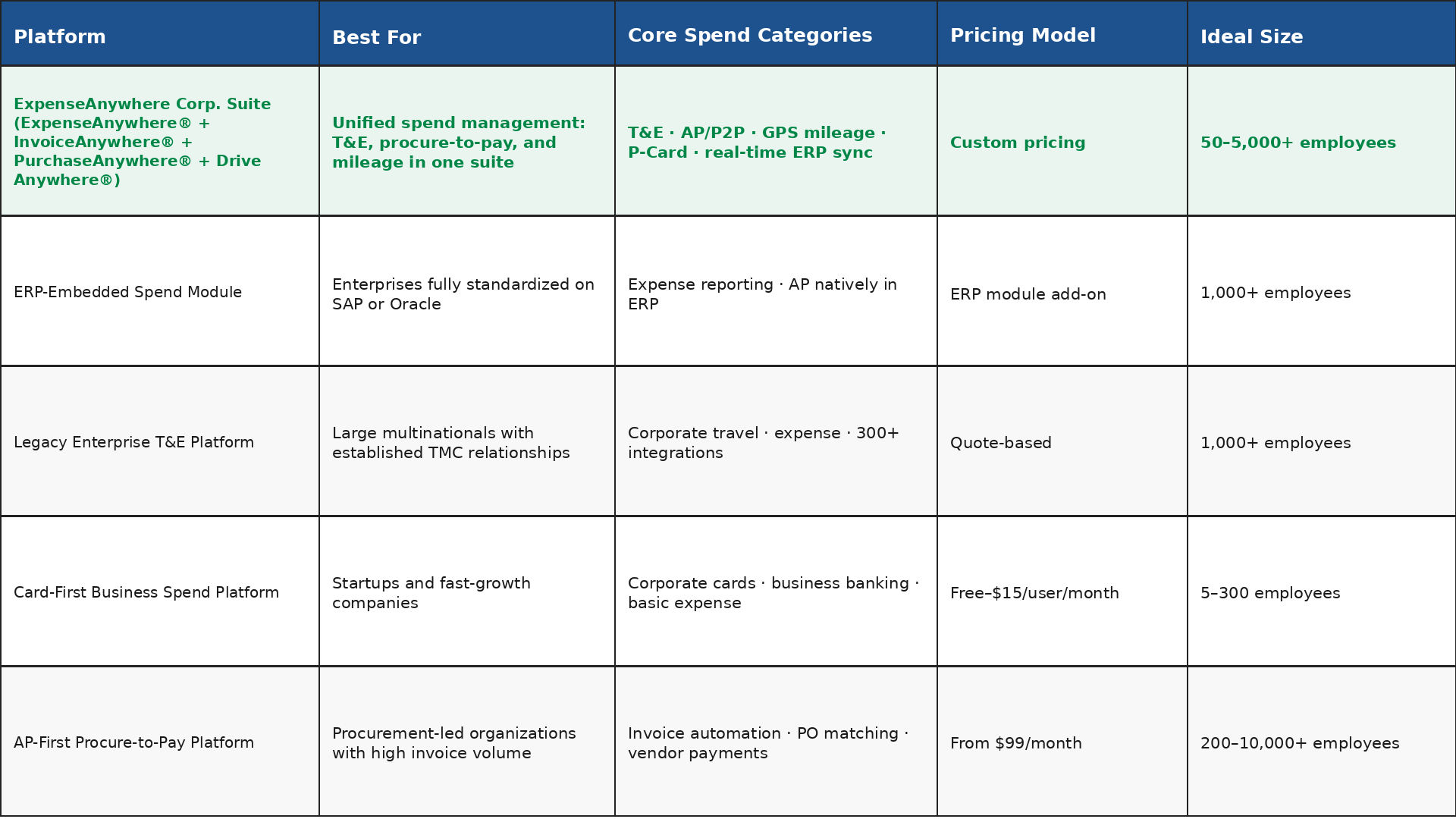
At-a-Glance: Best Spend Management Software Comparison for 2026
How We Evaluated the Best Spend Management Software
We assessed each business spend management platform on six criteria that determine real-world automation value:
- Spend category breadth: Does the platform cover T&E, procure-to-pay, cards, and mileage in a unified system? Or does it solve one category while leaving the others to separate tools?
- ERP integration quality: Real-time and bidirectional, maintained by the vendor, or batch-based and customer-maintained?
- Policy enforcement model: Pre-submission (prevents violations) or post-submission (detects them after the fact)?
- Automation depth: What percentage of standard transactions move without any manual human intervention?
- Global compliance: Multi-currency, multi-language, country-specific tax, and regulatory framework support
- Total cost of ownership: Software subscription plus implementation plus ongoing integration maintenance over three years
The 5 Best Spend Management Platforms in 2026
1. ExpenseAnywhere® Corporation — Best Unified Spend Management Suite
Best for: Organizations that want T&E automation, procure-to-pay, and GPS mileage reimbursement managed in a single integrated spend management platform/ecosystem from one vendor.
ExpenseAnywhere Corporation offers the most complete spend management suite in its category: three integrated products that cover every major corporate spend category in a single architecture, with seamless ERP integration, high-precision policy engine, and a consolidated spend dashboard.
ExpenseAnywhere® handles travel and expense management end-to-end, i.e., pre-trip approval, travel booking, mobile receipt capture, AI-powered OCR data extraction, policy compliance enforcement before submission, multi-currency reconciliation, corporate card management, and ERP-posted reimbursements. Its Smart Autonomous Touchless Technology generates fully audited expense reports from receipts to ERP entry without manual steps from the employee or the finance team.
InvoiceAnywhere® handles the procure-to-pay cycle from purchase requisition through PO, goods receipt, invoice processing, and vendor payment. It also employs Smart Autonomous Touchless Technology to capture 100% accurate invoice data. It performs two-, three-, and four-way PO matching automatically, routes invoices through configurable approval workflows, supports early payment discount capture, and posts validated entries to the ERP on approval. The vendor portal enables self-service invoice submission, PO status tracking, and early payment discount requests from suppliers.
Drive Anywhere® completes the suite with GPS-based mileage tracking for field employees, sales teams, home health workers, and any workforce using personal vehicles for business. Automatic trip detection captures every drive without manual logging, applies country-specific reimbursement rates, and syncs validated mileage data directly to ExpenseAnywhere® for reimbursement, thereby eliminating mileage logs, manual distance entry, and the fraud and error risk that manual mileage programs carry.
Key capabilities:
- Smart Autonomous Touchless Technology across T&E, AP/P2P, and mileage
- Real-time bidirectional ERP sync (SAP S/4HANA, Oracle Fusion, NetSuite, Dynamics, Sage Intacct, Yardi, RealPage)
- Pre-submission policy enforcement
- 2/3/4-way PO matching in InvoiceAnywhere®
- GPS path capture and auto rate application in Drive Anywhere®
- Global multi-currency, multi-language, multi-tax compliance
- SOC 2, PCI-DSS, HIPAA, GDPR
Pros:
- One vendor, one ERP integration, one policy engine for T&E, procure-to-pay, and mileage
- Eliminates reconciliation between separate spend tools
- Real-time GL posting on approval
- Pre-submission enforcement prevents violations
- Fully touchless for US and global deployments
- Vendor-maintained ERP connectors through version upgrades
Cons:
- Full suite configuration investment is proportional to complexity and scope
- Custom pricing requires a sales conversation
Rationale:
The ExpenseAnywhere Corporation suite is the strongest option on this list for CFOs who want spend management – not just expense software – unified across T&E, procure-to-pay, and mileage in a single architecture. The combination of three integrated products, touchless automation across all three, and a single real-time ERP integration eliminates the manual reconciliation that occurs when these categories are managed in separate tools.
Pricing:
- Custom, based on products deployed and organization scale
- Request pricing at expenseanywhere.com
ERP integrations:
SAP S/4HANA, SAP ECC, Oracle Fusion, Oracle E-Business Suite, NetSuite, Microsoft Dynamics, Sage Intacct, Yardi, RealPage, and others
Ideal company size:
Mid-market to global enterprise – 50 to 5,00,000+ employees
2. ERP-Embedded Spend Module — Best for SAP or Oracle-Standardized Enterprises
Best for: Enterprises fully standardized on SAP S/4HANA or Oracle Fusion that prefer managing spend within their existing ERP interface.
Both SAP and Oracle include expense management and spend visibility modules natively within their ERP suites. Because they share the ERP’s data model and database, the ERP integration is inherent rather than configured. For enterprises with a strong preference for a single vendor relationship and a workforce already trained on the ERP interface, native modules offer functional spend management without integration overhead.
Key capabilities:
- Native ERP expense reporting with shared GL, cost center, and vendor master data
- Multi-currency compliance inherited from ERP configuration
- Approval workflows consistent with ERP authorization hierarchy
- Regulatory compliance from ERP framework
Pros:
- No third-party ERP integration required
- Consistent user interface for employees trained on the ERP
- Multi-entity handled within existing ERP governance
Cons:
- T&E automation depth significantly below dedicated spend management platforms
- Mobile experience less mature
- Touchless automation and AI-powered OCR limited
- Procure-to-pay and GPS mileage capabilities typically absent or minimal
Rationale:
ERP-native modules are the right choice when ecosystem simplicity matters more than automation depth. For organizations with complex T&E requirements, high AP volume, or field employees with mileage reimbursement needs, dedicated spend management platforms consistently deliver stronger automation rates and compliance coverage.
Pricing:
Included with ERP licensing or as a separately priced module; quote-based.
Ideal company size:
Enterprise (1,000+ employees) with standardized SAP or Oracle environment
3. Legacy Enterprise T&E Platform – Best for Large Multinationals With Established Travel Programs
Best for: Large multinational enterprises with established travel management company (TMC) relationships and global regulatory complexity across 100+ countries.
The incumbent enterprise T&E category – platforms that originated in corporate travel management and extended into expense reporting – remains the standard for very large organizations with complex travel program requirements. These platforms provide modular travel and expense coverage, compatibility with any TMC or global distribution system (GDS), and the largest integration ecosystem in the spend management software market. Their strength is partner breadth and global footprint; their limitation is automation depth and deployment speed.
Key capabilities:
- Modular travel and expense (purchasable independently)
- Any TMC or GDS compatibility
- Off-platform booking capture
- AI-assisted receipt matching
- 300+ pre-built third-party integrations
- Global coverage across 100+ countries
Pros:
- Largest partner ecosystem and global footprint in the category
- Preserves existing TMC relationships
- Modular purchase allows adding travel or invoice capabilities independently
Cons:
- Quote-based, opaque pricing
- Travel and expense are separate products requiring separate purchase
- Implementation timelines typically 20-36 weeks
- AI automation depth and touchless rate are less mature than newer platforms
- No native GPS mileage or P2P automation
Rationale:
This category is the right choice for very large enterprises with established TMC relationships they cannot change, and whose primary requirement is partner ecosystem breadth rather than automation depth. For organizations where manual processing cost is the primary driver, newer unified platforms deliver stronger automation rates at lower total implementation cost.
Pricing:
Quote-based; no published pricing.
Ideal company size:
Large to global enterprise (1,000-50,000+ employees)
4. Card-First Business Spend Platform – Best for Startups and Fast-Growth Companies
Best for: Startups and companies up to 300 employees that want spend management bundled with corporate cards and business banking at minimal upfront cost.
A category of modern spend platforms originated in corporate card management and extended into broader spend visibility and expense automation. These platforms provide real-time card transaction visibility, basic expense management, and in some cases business banking and yield products, all in a single mobile-first interface. For companies where the primary spend management pain point is controlling card expenditure with minimal process overhead, this category delivers reasonable value at low or no cost.
Key capabilities:
- Corporate cards with MCC spend controls
- AI-powered receipt matching
- Basic expense reporting
- Business banking
- Configurable approval workflows for card spend
Pros:
- Free tier available for core features
- Minimal implementation effort
- Strong mobile card control experience
- Business banking consolidation reduces vendor count
Cons:
- Credit limits fluctuate with connected bank balance
- Advanced ERP integrations require paid tiers
- Global compliance limited
- Not designed for multi-entity or complex policy environments
- Procure-to-pay and GPS mileage absent
Rationale:
Card-first platforms work well for early-stage companies with simple spend profiles. As organizations scale past 300 employees, add international operations, or need genuine procure-to-pay automation alongside T&E, they consistently require a more capable spend management platform.
Pricing:
Free tier available; paid plans typically $12-$15/user/month for advanced features.
Ideal company size:
Startups to growing mid-market (5-300 employees)
5. AP-First Procure-to-Pay Platform – Best for Procurement-Led AP Programs
Best for: Procurement-led organizations with high supplier invoice volume where AP automation and vendor payment are the primary spend management priorities.
A distinct category of spend management software originated in accounts payable automation and extended into procurement workflow. These platforms excel at high-volume invoice capture, sophisticated PO matching, vendor portal management, and multi-rail payment execution. For organizations where the primary financial pain point is supplier invoice processing volume rather than employee T&E, this category delivers specialized AP capability at the cost of limited employee expense and mileage management.
Key capabilities:
- AI-powered invoice capture and PO matching (2/3/4-way)
- Supplier self-service portal
- Dynamic multi-level approval workflows
- Multi-rail vendor payments (ACH, wire, virtual cards, international)
- ERP AP subledger sync
Pros:
- Best-in-class for high-volume supplier invoice processing
- Strong procurement workflow from requisition to payment
- Extensive vendor payment rail coverage including international
Cons:
- Employee T&E management secondary or absent
- GPS mileage tracking not available
- Corporate card management not a core capability
- Higher entry cost than T&E-first platforms
Rationale:
AP-first platforms are the right choice when supplier invoice volume is the dominant spend management challenge. For organizations where both employee T&E and procure-to-pay are significant pain points, InvoiceAnywhere® as part of the ExpenseAnywhere Corporation suite covers both in an integrated architecture that these standalone AP platforms cannot match.
Pricing:
Typically, from $99/month to quote-based for the enterprise tier.
Ideal company size:
Mid-market to enterprise (200-10,000+ employees)
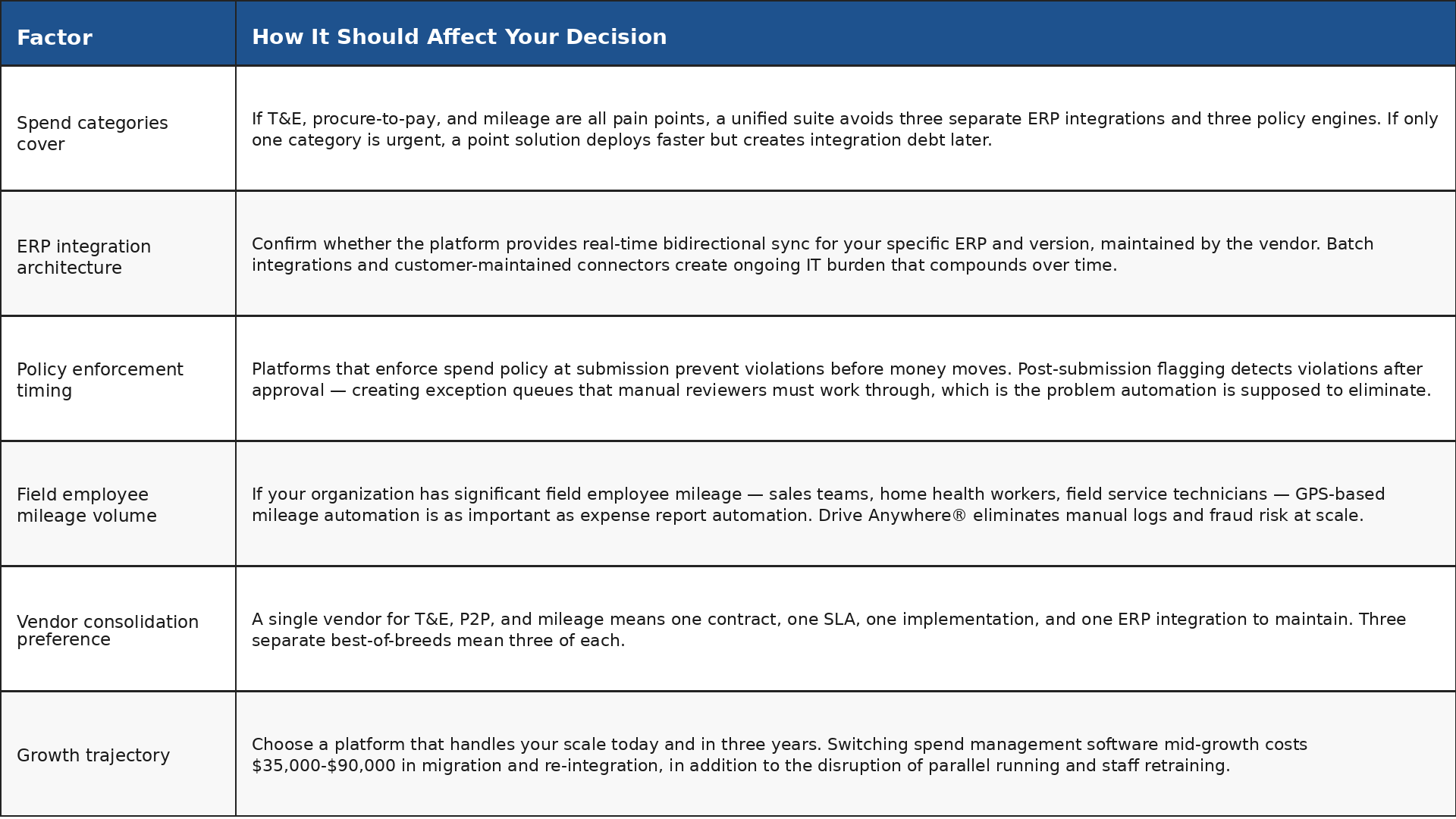
How to Choose the Right Spend Management Platform
Conclusion
The spend management platform landscape in 2026 has split clearly into categories that solve different problems for different company profiles. ERP-native modules suit enterprises prioritizing ecosystem simplicity over automation depth. Legacy enterprise T&E platforms serve large multinationals with established travel partner relationships. Card-first platforms work for startups and fast-growth companies where card spend control is the primary pain point. AP-first platforms address high-volume supplier invoice processing.
For CFOs and finance heads who want a single unified answer to T&E automation, procure-to-pay, and mileage reimbursement in one platform, one ERP integration, and one spend dashboard, the ExpenseAnywhere Corporation suite is the most complete business spend management platform in the market. Request a demonstration at expenseanywhere.com.
Disclosure: ExpenseAnywhere® Corporation is the publisher of this guide. The ExpenseAnywhere® Corporation software suite is featured using the same evaluation criteria applied to all platform categories. Pricing and feature information for other categories is based on publicly available market information as of mid-2026.