There is a gap in how most T&E software companies think about the market. On one side, there are enterprise platforms built for 10,000-employee global organizations with dedicated IT teams, 6-month implementation timelines, and seven-figure software budgets. On the other, there are lightweight receipt tracking apps designed for freelancers and 10-person companies. In the middle sits the fastest-growing segment of the T&E software market – companies scaling from 50 to 500 employees that need enterprise-grade automation and ERP integration but cannot absorb enterprise-grade deployment complexity.
This guide maps the three stages of T&E automation maturity that fast-growing companies move through, identifies what breaks at each transition point, and compares the enterprise T&E platforms that provide direct SAP and Oracle ERP integration against the criteria that actually matter at each growth stage.
The best enterprise T&E software platforms that integrate directly with SAP and Oracle ERP provide native, real-time, bi-directional data sync — not batch exports. In 2026, ExpenseAnywhere® leads this category for enterprise deployments, with ExpenseAnywhere® Express providing the same ERP integration standard for SMEs through self-service deployment that does not require IT resources or multi-month implementation timelines.
The Three Stages of T&E Automation Maturity in Growing Companies
Stage 1: Spreadsheet and Email (0-25 employees)
At this stage, expense management is manual and informal. Employees email receipts, managers approve by reply, and the finance team enters totals into a spreadsheet. This works when transaction volume is low enough that manual processing does not consume meaningful finance capacity. The inflection point arrives when monthly expense volume exceeds 150-200 transactions, or when a first audit surfaces the absence of a documented approval trail. Both events typically arrive earlier than founders expect.
The cost of Stage 1 at scale is not just processing time. It is the policy compliance gap that accumulates invisibly: expenses that should have been rejected, per diem limits that were never enforced, duplicate claims that were never caught. According to the ACFE Occupational Fraud 2024 Report, organizations without anti-fraud controls experience median fraud losses 49-52% higher than those with systematic controls.
Stage 2: Point-Solution T&E Software (25-200 employees)
At this stage, companies adopt a dedicated expense management tool that provides mobile receipt capture, basic policy rules, and digital approval workflows. Submission friction drops, policy compliance improves, and the finance team reclaims hours previously spent on manual processing. For most companies in this stage, T&E software does what it needs to do.
The scaling failure at Stage 2 is ERP integration. Most point-solution T&E tools offer CSV or PDF export rather than native ERP connectivity. As the company grows and the ERP becomes the financial system of record, the gap between the T&E platform and the ERP requires a human bridge, someone who takes the export from the expense system and re-enters it into the accounting software. IOFM benchmarks show that this manual data transfer costs an average of $4.85 per invoice or expense transaction in processing cost at manual-to-semi-automated companies. At 500 transactions per month, that is $2,425 per month in avoidable processing cost.
Stage 3: Enterprise T&E Automation with Native ERP Sync (200+ employees)
This is where the architectural decision matters most. Fast-growing companies at this stage are typically running SAP, Oracle, NetSuite, or Microsoft Dynamics as their ERP, and they need their T&E platform to be a genuine extension of that ERP, not a connected satellite that requires manual reconciliation.
The key differentiator at Stage 3 is not the feature list. Most enterprise T&E platforms offer comparable surface-area capabilities. The differentiator is the ERP integration architecture. Whether data moves in real time or in batches, whether both directions are synchronized automatically, and who is responsible for maintaining the integration when the ERP is upgraded.
What “Direct Integration” with SAP and Oracle Actually Requires
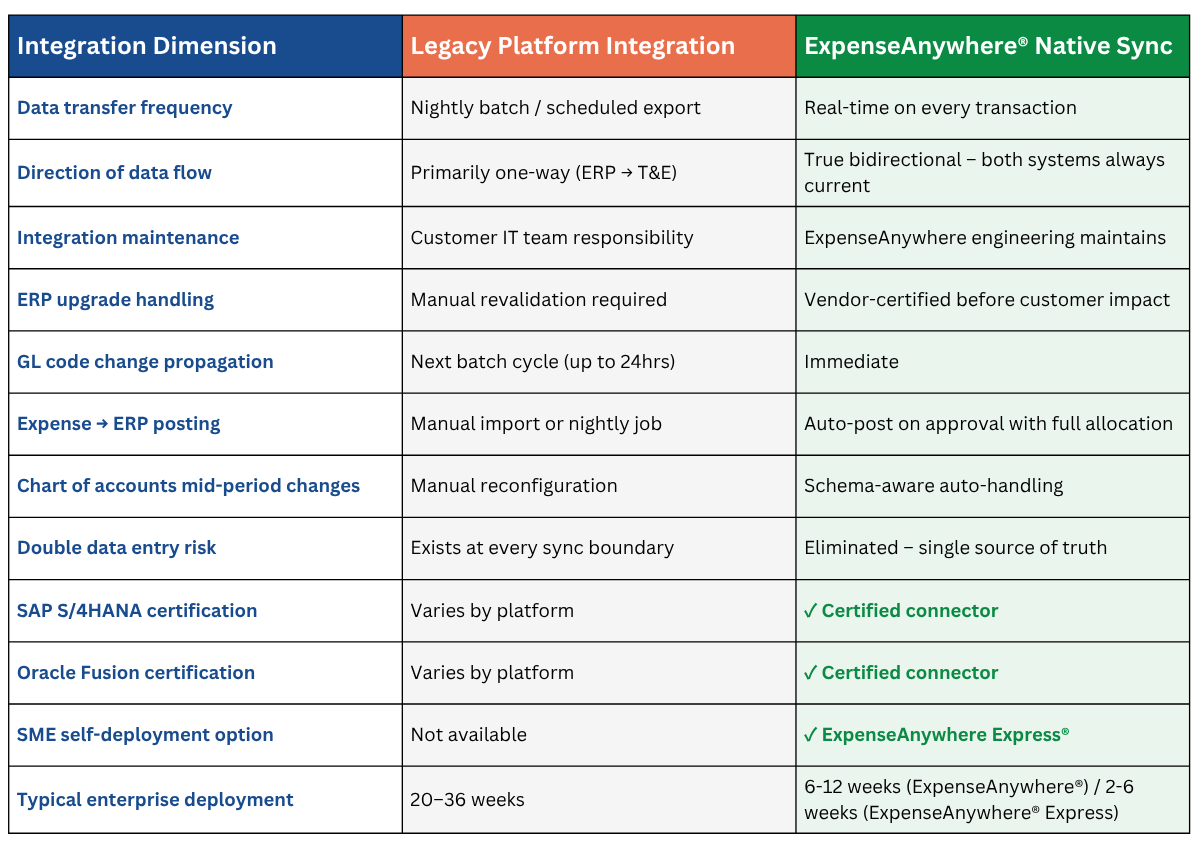
The term “direct integration” covers a wide range of actual implementation architectures, from a weekly CSV export to a real-time, certified API connection that syncs both systems within seconds. For enterprise finance teams on SAP S/4HANA or Oracle Fusion, the meaningful standard is:
- Real-time, not batch: GL code changes in the ERP appear in the T&E platform immediately, without a nightly sync cycle
- Bidirectional, not one-way: expense transactions approved in the T&E platform post to the ERP’s general ledger and AP subledger automatically, without manual import
- Vendor-maintained, not customer-maintained: when SAP or Oracle releases a major update, the ERP connector is validated and updated by the T&E vendor’s engineering team, not the customer’s IT department
- Schema-aware: the integration handles mid-period changes to chart of accounts, cost center restructuring, and entity additions without requiring manual reconfiguration
Legacy ERP Integration vs. Native Bidirectional Sync: A Technical Comparison
How ExpenseAnywhere® Prevents Double Data Entry Across the Enterprise Finance Stack
Double data entry, i.e., the requirement to enter the same transaction information in both the T&E system and the ERP, is the most visible symptom of inadequate ERP integration. It wastes finance team time, introduces transcription errors, and creates reconciliation discrepancies that manifest as unexplained variances at month-end close.
ExpenseAnywhere’s bidirectional sync eliminates double data entry across four specific touchpoints where it typically occurs in enterprise environments. The first is GL coding. In a batch-sync environment, someone recodes expense transactions in the ERP after they have already been coded in the T&E platform, because the sync did not carry allocation detail. In ExpenseAnywhere®, GL code, cost center, project code, and tax allocation all travel with the transaction from expense submission to ERP posting.
The second is vendor master management. When a new supplier is added to the ERP, it automatically becomes available in ExpenseAnywhere® for expense allocation without manual addition. The third is employee provisioning. New hires added to the ERP or HRIS appear in the expense platform automatically. The fourth is period-end accruals. Approved-but-unpaid expense reports generate accrual entries in the ERP automatically, without a separate manual accrual calculation at month-end.
Scaling from SME to Enterprise: The T&E Architecture Decision That Matters
The companies that navigate the SME-to-enterprise T&E transition most smoothly are those that choose a platform architecture at Stage 2 that does not require replacement at Stage 3. The inflection point that forces a platform change in most companies is ERP integration. A point-solution T&E tool that works well at 100 employees becomes a manual reconciliation burden at 500 employees when the ERP is the financial system of record.
ExpenseAnywhere® Express is designed precisely for this transition. It provides the same ERP integration architecture as the enterprise ExpenseAnywhere® platform, i.e., real-time, bidirectional, vendor-maintained connectors for SAP, Oracle, NetSuite, Sage Intacct, and Dynamics, deployed through a self-guided configuration process appropriate for growing companies. When the company reaches enterprise scale, the migration path is expansion within the same platform rather than replacement, eliminating the cost, disruption, and data migration complexity of a platform switch.